
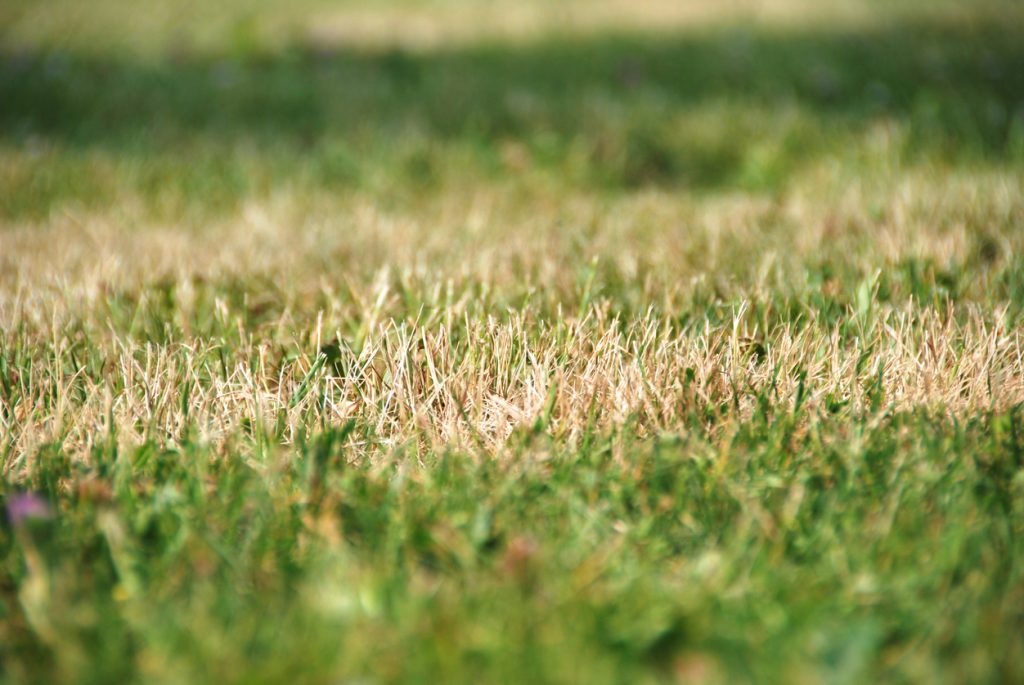
Every July and August, we get calls from homeowners across Fort Wayne and Marion who are convinced the summer heat killed a section of their lawn. They watered it. They mowed it right. But a patch near the driveway or sidewalk turned brown and died anyway. More often than people realize, the real culprit is not the heat. It is a tiny insect called the chinch bug.
What Are Chinch Bugs?
The hairy chinch bug (Blissus leucopterus hirtus) is a small insect that feeds on cool-season grasses — the same Kentucky bluegrass, tall fescue, and perennial ryegrass that make up most lawns in northeast Indiana. Adults are only about one-eighth of an inch long, roughly the size of a pinhead. They are black with white wings that fold flat across their backs.
At that size, you are not going to spot them from a standing position. That is part of what makes chinch bugs so destructive. By the time the damage is obvious, they have been feeding for weeks.
Purdue Extension's turfgrass insect guide (E-61-W) classifies chinch bugs as a key lawn pest in Indiana. They belong to a group of insects called true bugs, and they damage grass by piercing the blades with needle-like mouthparts, sucking out the plant's moisture, and injecting a toxin that clogs the grass plant's ability to move water. The grass yellows, then browns, then dies.
What Chinch Bug Damage Looks Like
Chinch bug damage starts as irregular patches of yellowing turf. At first, it looks a lot like drought stress — and that is exactly why so many homeowners miss it. Ohio State Extension's turfgrass factsheet (HYG-2503) describes the progression: the yellow patches turn brown and die, and the dead areas keep expanding outward as the bugs move to fresh grass at the edges.
There are a few things that set chinch bug damage apart from simple drought stress:
Location matters. Chinch bugs love heat. The damage almost always starts in the hottest, sunniest parts of your lawn — along sidewalks, driveways, south-facing slopes, and areas next to foundations. If a brown patch shows up right next to your driveway but the shady side of your yard looks fine, chinch bugs are a strong possibility.
Watering does not fix it. Drought-stressed grass recovers when you water it. Chinch bug damage does not. If you have been watering consistently and a patch keeps getting worse, something else is going on.
The edges keep moving. Drought stress tends to be even across an area. Chinch bug damage spreads outward from a center point because the bugs move to fresh grass once they kill what they are feeding on. Michigan State Extension notes that what starts as a small dead patch can quickly grow into a large area of dead grass as the population expands.
Why Summer Is Peak Season
Chinch bugs overwinter as adults in the thatch layer of your lawn. When temperatures warm up in spring, they start feeding and laying eggs. Each female can lay several hundred eggs over a few weeks. Those eggs hatch into tiny red nymphs that are even harder to see than the adults.
Iowa State Extension's turfgrass program explains that chinch bug damage typically shows up from June through August. Hot, dry weather accelerates their feeding and reproduction. A rainy summer slows them down, but a stretch of 90-degree days with little rain — exactly the kind of July and August we get in Fort Wayne and Marion — creates ideal conditions for a chinch bug explosion.
By mid-summer, a single lawn can have two overlapping generations feeding at the same time. That is when the damage gets severe fast.
Thick Thatch Makes It Worse
Chinch bugs thrive in lawns with a thick thatch layer. Thatch is that spongy layer of dead stems and roots between the grass blades and the soil surface. A thin layer (under half an inch) is normal and even helpful. But when thatch builds up past that, it becomes a hiding spot and breeding ground for chinch bugs.
Ohio State Extension specifically identifies heavy thatch as a factor that increases chinch bug problems. The thick thatch insulates the bugs from temperature extremes and makes it harder for any treatment to reach them.
This is one reason we recommend core aeration as part of a complete lawn care program. Aeration breaks up thatch and reduces the habitat that chinch bugs depend on. It does not eliminate them on its own, but a lawn with managed thatch is far less attractive to these pests than one that has been neglected.
How the Pros Find Them
Because chinch bugs are so small, finding them takes some effort. The standard detection method is called a float test. You take a coffee can with the top and bottom cut off, push it a couple of inches into the turf at the edge of a damaged area, and fill it with water. If chinch bugs are present, they float to the surface within five to ten minutes.
Michigan State Extension recommends repeating this test in several spots around the lawn to understand how widespread the problem is. Our technicians know where to look and what they are seeing — the nymphs are tiny, brick-red, and easy to mistake for other insects. Getting a correct identification matters because the treatment approach for chinch bugs is different from other lawn pests like grubs.
If you are seeing brown patches expanding through your lawn this summer and you are not sure what you are looking at, give us a call at either our Fort Wayne or Marion office. We can take a look and tell you exactly what is going on.
Why This Is Not a DIY Guessing Game
Chinch bug damage, drought stress, and lawn disease can all look nearly identical from the surface. Brown patch fungus, dollar spot, and even grub damage create similar brown, dead areas in summer lawns. Treating for the wrong problem wastes time and money while the real issue keeps spreading.
Timing matters too. Penn State Extension notes that chinch bug populations peak in mid to late summer, and damage can escalate quickly once it starts. A week of delay can mean the difference between saving a section of lawn and losing it entirely.
Our lawn insect and disease program is built to catch problems like this early. We know what chinch bug damage looks like because we see it on properties across Fort Wayne and Marion every summer. And we know the difference between chinch bugs, grubs, fungal disease, and simple heat stress — distinctions that are hard to make without experience and training.
Keeping Your Lawn Less Attractive to Chinch Bugs
While professional treatment is the answer when chinch bugs show up, there are things you can do to make your lawn a less inviting target.
Water deeply and consistently. Chinch bugs do the most damage in dry, stressed turf. Following the D.I.E.T. watering method — about an inch per week in one or two deep soakings — keeps your grass healthier and more resilient. Our free tool at WaterOrNot.com can help you decide when to water based on local conditions.
Mow at the right height. Keeping your grass at 3 to 3.5 inches through the summer shades the soil and keeps it cooler — conditions that chinch bugs do not prefer.
Keep thatch in check. If your thatch layer is more than half an inch thick, core aeration in the fall is the best way to reduce it. We handle that as part of our fall lawn care program.
Seeing Brown Patches That Won't Recover?
Chinch bugs, grubs, and lawn disease all look similar from the surface. Our team diagnoses and treats lawn insect problems across Fort Wayne and Marion — call either office to get it checked out.
Fort Wayne: 260-432-8900 | Marion: 765-660-8873