
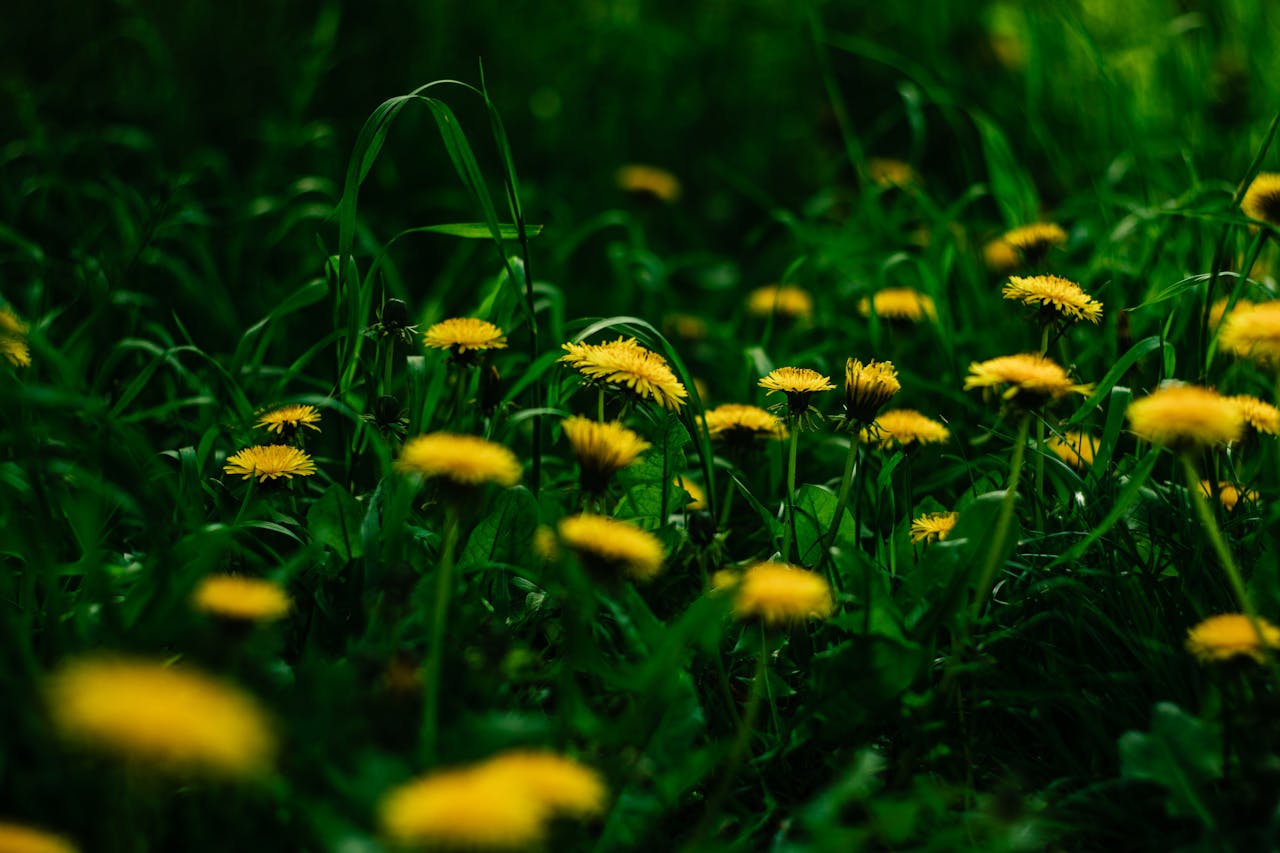
Nothing says spring in Fort Wayne and Marion like a yard full of bright yellow dandelions. They show up fast, spread faster, and seem impossible to get rid of. Here is a straightforward look at what actually works — and where the line is between hand-pulling, spraying, and calling in a pro.
Why Dandelions Are So Hard to Beat
Dandelions (Taraxacum officinale) are perennials. That means they come back from the same root year after year. They do not die at the end of the season like crabgrass does. The root can grow 6 to 18 inches deep, and if you snap off even a small piece, it can regrow into a new plant.
A single dandelion plant can produce thousands of seeds in a year. Those white puffballs that kids love to blow? Each one carries seeds that can travel hundreds of feet on the wind. That is why your lawn can go from a few dandelions to hundreds in a single season.
They also flower and set seed incredibly fast. From first bloom to puffball can take less than two weeks. By the time you notice them, seeds are already blowing around the neighborhood.
Option 1: Pull Them
Pulling dandelions by hand works, but only if you get the entire taproot. If you snap the root off at the surface, the plant grows right back. You need to get at least 3 to 4 inches of the root to kill the plant.
A dandelion weeding tool (sometimes called a weed popper or taproot puller) makes this much easier than pulling by hand. Wait until after a rain when the soil is soft, push the tool down alongside the root, and lever the whole plant out.
Hand-pulling is practical for small populations, like a dozen or fewer plants in the lawn. For larger infestations, it is not realistic. You would spend hours and still miss roots that will regrow.
Best for: Small numbers of dandelions in otherwise healthy turf. People who prefer not to use herbicides.
Option 2: Spray Them
Broadleaf herbicides are the most effective way to control dandelions, but the details matter. Active ingredients like 2,4-D, dicamba, and triclopyr target broadleaf weeds without harming grass, and they are the backbone of our weed control programs. The right product, the right rate, and the right conditions are what separate a treatment that kills the root from one that just bruises the leaves, which is why a lot of homeowners in Fort Wayne and Marion hand this part to us instead of fighting it from a spray bottle.
Here is the important part about timing. The best time to treat broadleaf weeds like dandelions is in the fall, typically September through mid-October. This is when dandelions are pulling nutrients down into their roots for winter storage. Herbicide applied in fall gets transported deep into the root system along with those nutrients, which gives you a much better kill rate.
Spring applications can work, but they are less effective. In spring, the plant is pushing energy upward into leaves and flowers, so the herbicide does not move down to the root as well. You may knock back the top growth, but the root survives and the plant returns.
Spring treatments can work, but only when conditions cooperate — temperatures between 60 and 80 degrees, dandelions actively growing, no wind, and no heat or drought stress on the lawn. Those windows can be short and easy to miss. Our spring and fall broadleaf programs are scheduled around exactly those conditions, which is the difference between a treatment that takes and one that fizzles out.
Best for: Moderate to heavy infestations. Lawns that need a weed-free finish without trial and error from a spray bottle.
The Real Fix: A Thicker Lawn
Here is what every turf scientist will tell you: the best defense against dandelions is thick, healthy grass. A dense lawn shades the soil surface, which prevents dandelion seeds from getting the sunlight they need to germinate.
Proper mowing height (3 to 3.5 inches for Kentucky bluegrass), regular fertilization, and overseeding thin areas are more effective long-term strategies than herbicides alone.
If you have a dandelion problem, ask yourself: why is my lawn thin enough to let them in? The answer is usually one or more of these: mowing too short, not fertilizing enough, compacted soil that needs aeration, or bare spots that never got reseeded.
Fix those issues and the dandelion population drops dramatically — and paired with targeted fall treatment, that is how lawns get clean. Combine cultural practices with targeted fall herbicide applications and you can get almost any lawn to a manageable level within one to two seasons.
A Practical Plan for Northeast Indiana
Here is a simple season-by-season approach that works well in the Fort Wayne and Marion area:
Right now (April): Mow at 3 to 3.5 inches. Do not scalp. If dandelions are flowering, mow before the puffballs form to reduce seed spread.
May through August: Focus on growing thick, healthy grass. Fertilize on schedule, water properly, and do not let the lawn thin out.
September: This is when we apply broadleaf treatment — dandelions are actively growing and pulling nutrients into their roots, so the treatment gets carried straight to the root. This is your best shot at a long-lasting kill, and it is when professional-grade broadleaf treatments make the biggest difference — the equipment and product concentration are hard to match with consumer spray bottles.
October: Overseed any thin or bare areas so the lawn goes into winter thick and competitive.
We see this pattern play out on properties across Fort Wayne and Marion every year. The lawns that look best by the following spring are the ones that got fall broadleaf treatments and overseeding. If you are not sure what your lawn needs, give us a call at either our Fort Wayne or Marion office. We are happy to walk through it with you.
Sources
- Purdue Extension AY-27-W, "Maintenance Calendar for Indiana Lawns" — PDF