
You might not see them, but white grubs could be chewing through your lawn right now. These C-shaped larvae live in the soil and feed on grass roots, and by the time you notice the damage, they have been at it for weeks. Here is what every Fort Wayne and Marion homeowner should know about grubs and when to act.
What Are Grubs, Exactly?
White grubs are the larval stage of several species of beetles. In northeast Indiana, the most common are Japanese beetles (Popillia japonica), European chafers, and masked chafers. The adults are the beetles you see flying around in summer. The larvae are plump, white, C-shaped grubs with brown heads that live in the soil and feed on grass roots.
Purdue Extension's guide to white grubs in lawns (E-44-W) explains the basic lifecycle. Adult beetles lay eggs in the lawn in June and July. The eggs hatch into tiny grubs that begin feeding on roots immediately. The grubs grow all summer and fall, do the most damage in September and October, then burrow deeper into the soil to survive winter. In spring, they move back up to the root zone, feed briefly, pupate, and emerge as adult beetles to start the cycle again.
How to Know If You Have Grubs
Grub damage looks a lot like drought stress at first. The grass turns brown in irregular patches, usually in sunny areas of the lawn. But here is the key difference: drought-stressed grass is firmly rooted. Grub-damaged grass pulls up like a carpet because the roots have been eaten away.
Try this test. Go to the edge of a brown patch and grab a handful of grass. Pull straight up. If it peels away from the soil easily, with no roots holding it down, you likely have grubs. Purdue Extension describes this "roll-back" test as the simplest diagnostic method.
You can also cut a 1-foot square of turf about 3 inches deep and flip it over. Count the grubs you see. Purdue Extension uses a threshold of 8 to 10 grubs per square foot as the level at which damage becomes visible and treatment is justified. A few grubs are normal and not a problem.
Other signs to watch for:
Skunks and raccoons digging up your lawn. These animals can smell grubs underground and will tear up turf to get at them. If you wake up to patches of lawn ripped apart, grubs are the likely reason.
Increased mole activity. Moles eat grubs (among other soil insects). A sudden increase in mole tunnels often correlates with a grub population worth addressing.
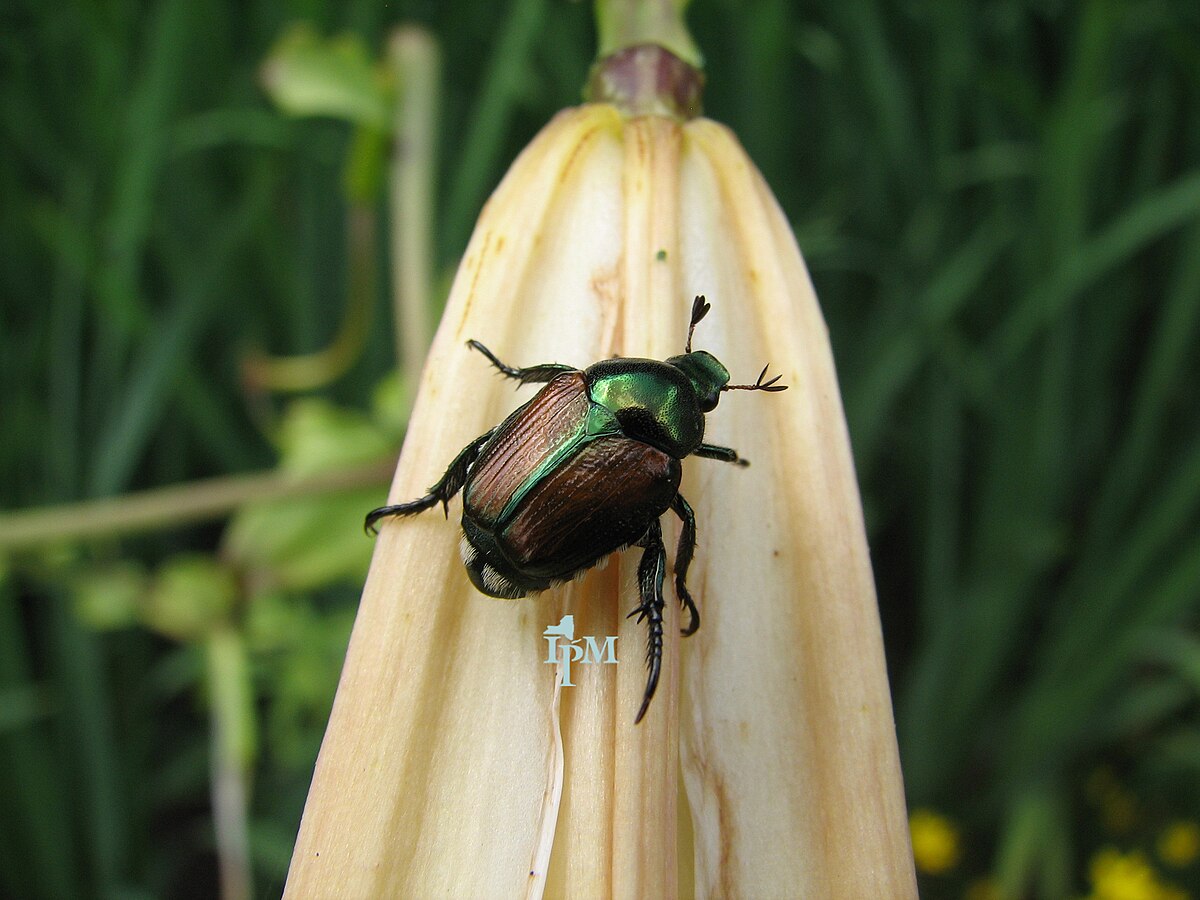
Japanese beetles on your plants. If you see metallic green-and-copper beetles skeletonizing your rose bushes, linden trees, or grape vines in July, their larvae are probably in your lawn. Ohio State Extension notes that Japanese beetle adults are strong fliers and may come from neighboring properties, but heavy adult feeding nearby increases the odds of local egg-laying.
Prevention vs. Cure
There are two approaches to grub control, and the timing is completely different.
Preventive treatment (June through mid-July): Products containing chlorantraniliprole (the active ingredient in GrubEx) or imidacloprid are applied before the eggs hatch or while the grubs are tiny and most vulnerable. Purdue Extension recommends preventive applications in June or early July for best results. These products need to be watered into the soil with at least half an inch of irrigation after application.
Preventive treatment is the most effective and most reliable approach. It kills grubs while they are small and before they do significant damage. The window is narrow, though. Apply too early and the product breaks down before the grubs arrive. Apply too late and the grubs are too large for preventive-rate products to kill.
Curative treatment (late August through September): If you missed the preventive window and find grubs in the fall, curative products like trichlorfon (Dylox) can knock down active grub populations. These work on larger grubs but are not as effective as preventive treatment. Purdue Extension notes that curative products should be applied when grubs are actively feeding near the surface, typically in September.
Iowa State Extension adds that curative treatments work best when soil is moist and grubs are in the top 1 to 2 inches of soil. If the soil is dry and grubs have moved deeper, efficacy drops significantly.
Do You Even Need to Treat?
Not every lawn needs grub treatment every year. Purdue Extension explicitly recommends against routine preventive applications on lawns with no history of grub damage. The products are effective but not free, and unnecessary pesticide use is not good for the environment or your wallet.
Treat preventively if your lawn has had grub damage in the past two years, if you see heavy Japanese beetle adult activity in your yard, or if neighbors are dealing with grub problems. Otherwise, monitor with the roll-back test in September and treat only if you find damaging populations.
What About Milky Spore and Nematodes?
Milky spore disease (Paenibacillus popilliae) is a biological control that targets Japanese beetle grubs specifically. It is applied to the lawn and builds up in the soil over several years. Purdue Extension notes that milky spore can provide long-term Japanese beetle grub suppression, but it takes two to four years to build up effective levels and does not control European chafer or masked chafer grubs.
Beneficial nematodes (Heterorhabditis bacteriophora) are another biological option. These microscopic organisms parasitize grubs in the soil. Michigan State Extension describes them as most effective when applied to moist soil in late August or September when grubs are small and active near the surface. They need to be kept refrigerated before use and applied according to label directions for best results.
Both biological options are less immediately effective than chemical treatments but offer longer-term, lower-impact control for homeowners who prefer to avoid synthetic pesticides.
After the Damage
If grubs have already killed patches of your lawn, you will need to repair them. Wait until you have addressed the grub problem, then overseed or resod the damaged areas. September is the ideal time for both grub treatment and lawn repair in northeast Indiana.
Press the loose turf back down and water it well. If roots are completely gone, the turf is dead and will need to be replaced. Rake out the dead material, loosen the top inch of soil, and seed or sod.
Sources
- Purdue Extension E-44-W, "White Grubs in Lawns" — PDF
- Purdue Extension E-62-W, "Japanese Beetle" — PDF
- Ohio State Extension, "Japanese Beetles in the Urban Landscape" — Link
- Iowa State Extension, "White Grub Management in Turfgrass" — Link
- Michigan State Extension, "Using Nematodes to Control White Grubs" — Link