Drive through any neighborhood in Fort Wayne or Marion right now and you will see them everywhere. Big cones of mulch piled against tree trunks, sometimes six or eight inches high. It looks neat. It looks intentional. And it is slowly killing the trees underneath.
What Is a Mulch Volcano?
A mulch volcano is exactly what it sounds like. Mulch gets stacked against a tree trunk in a cone shape, burying the base of the tree under a mound of wood chips. The trunk disappears into the pile like a fence post stuck in the ground.
It happens for a simple reason: people think more is better. If two inches of mulch is good, a foot must be great. And piling it right against the trunk keeps everything looking tidy. But trees did not evolve to have their trunks buried. The bark at the base of a tree is designed to be exposed to air and sunlight. When you bury it, bad things start happening underground where you cannot see them.
The Slow Damage You Cannot See
Mulch volcanoes do not kill trees overnight. That is what makes them so dangerous. The damage builds over years, and by the time you notice the tree declining, it is often too late to reverse.
Bark decay and moisture damage
Tree bark is built to handle rain and dry out quickly between storms. When mulch holds constant moisture against the trunk, the bark starts to break down. Purdue Extension's tree installation guide (FNR-433-W) stresses that no mulch should ever be in direct contact with the trunk. The constant dampness creates ideal conditions for fungal pathogens to attack the living tissue just under the bark.
We see this on properties across Fort Wayne and Marion every spring. A homeowner calls because their tree "just started declining," and when our team pulls back the mulch, the bark underneath is cracked, soft, and rotting. The damage has been building for years without any visible sign above the mulch line.
Girdling roots: the tree strangles itself
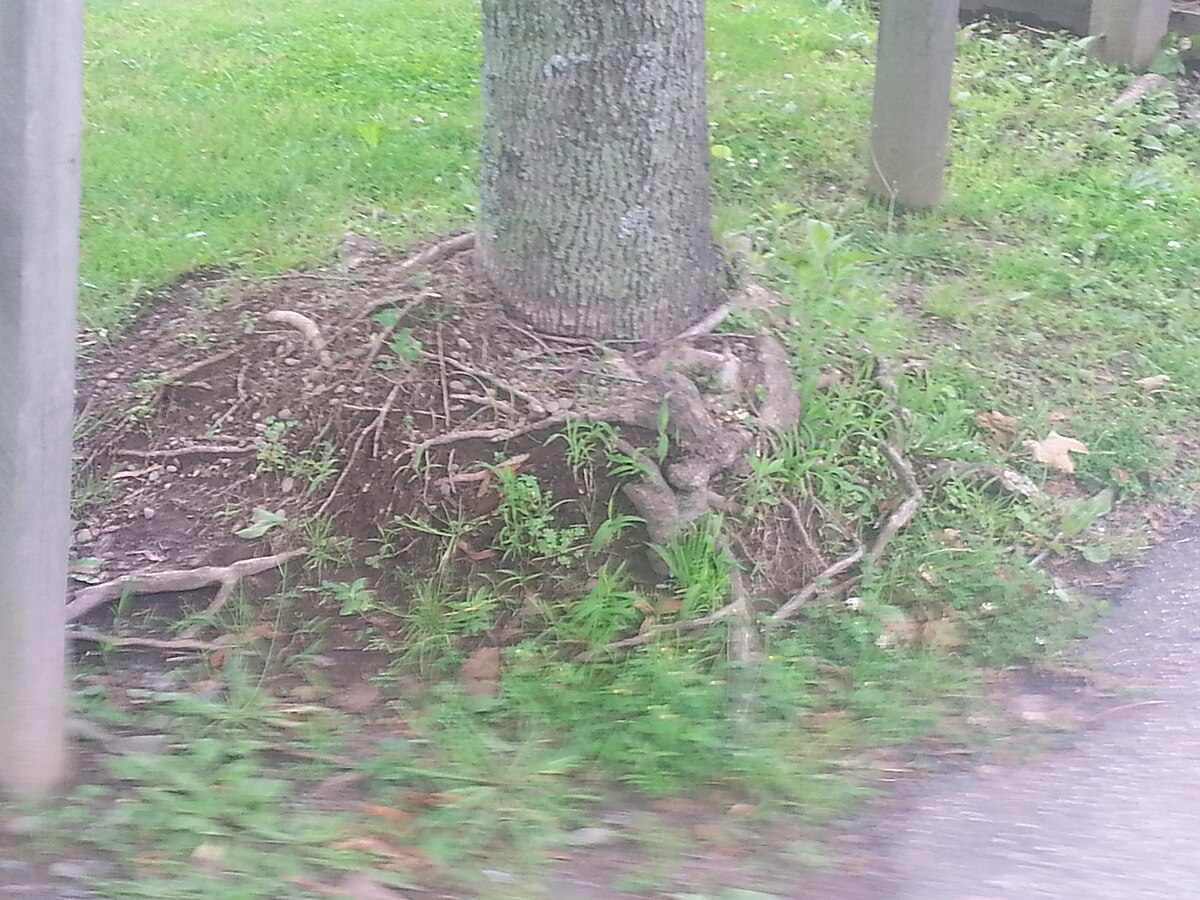
This is the biggest problem, and it is the hardest to fix. When mulch is piled high against the trunk, the tree responds by growing new roots up into that warm, moist mulch. Those roots have nowhere to go but sideways, and they start circling the trunk.
Ohio State Extension's Buckeye Yard and Garden Line has documented this extensively. As these circling roots grow larger year after year, they gradually squeeze the trunk and choke off the flow of water and nutrients. The technical term is stem girdling roots, and it is the tree slowly strangling itself from the outside in.
Here is the worst part: this damage is not reversible. Once girdling roots have been wrapping around the trunk for several years, removing them causes so much injury that it can kill the tree outright. Ohio State researchers note that in their field work excavating volcano-mulched trees, they consistently found girdling roots underneath. It is not a question of "if" but "when."
Pest and rodent habitat
That thick, damp cone of mulch pressed against the trunk is also a perfect home for insects, rodents, and fungi. Bark beetles, carpenter ants, and voles all love the protected environment a mulch volcano creates. Voles are especially damaging in Indiana winters. They tunnel through the mulch and gnaw on the bark, sometimes girdling young trees completely before spring.
Root suffocation
Even away from the trunk, excessive mulch depth hurts. Tree roots need oxygen. The International Society of Arboriculture (ISA) warns that mulch piled too deep reduces oxygen in the root zone and can actually become hydrophobic, meaning water runs off the surface instead of soaking through to the roots. Your tree can be surrounded by mulch and still be thirsty.
What Right Looks Like
Mulch done properly is one of the best things you can do for a tree. The ISA's guidelines are clear: a 2 to 4 inch layer of mulch spread in a wide ring around the tree, extending out at least 3 to 5 feet from the trunk. Purdue Extension recommends 2 to 3 inches.
The critical detail is at the center. There should always be a gap of several inches between the mulch and the trunk. You should be able to see the root flare, that slightly swollen area where the trunk widens out and meets the first major roots. If you cannot see the root flare, something is wrong.
Think donut, not volcano. Flat, even, and open in the middle.
Purdue's Landscape Report also emphasizes that total mulch depth matters. That means accounting for what is left from previous years, not just what you add this spring. Every fresh layer piled on top of old mulch gradually builds the volcano, even if each individual application seems reasonable.
Why This Keeps Happening
If mulch volcanoes are so harmful, why does everyone do it? A few reasons.
Dumping a pile against the trunk is faster than spreading a thin, even ring across a wide area. For crews mulching dozens of properties in a day, speed wins over technique. A tall cone also looks impressive to homeowners who equate volume with value.
Then there is the compounding problem. Even if the first year's application was fine, adding a fresh layer every spring without removing or redistributing the old mulch gradually builds the mound higher. After five or six years of this, you have a full-blown volcano and a tree in trouble.
How We Handle Mulch and Tree Health
Our tree and shrub program includes evaluating the root zone of every tree we treat. When we see mulch volcanoes, we flag them. When we see early signs of girdling roots or bark decay, we catch them before the canopy starts showing decline.
That is the difference between reactive tree care and proactive tree care. A tree that loses half its canopy to girdling root damage may already be beyond saving. A tree where we catch the problem early has a much better chance.
We work on properties across Fort Wayne, Marion, and the surrounding communities, and mulch volcanoes are one of the most common issues we find. Most homeowners have no idea the mulch is causing a problem until we point it out.
Worried About Your Trees?
Our team can assess mulch damage, check for girdling roots, and recommend the right treatment plan.
Fort Wayne: 260-432-8900 | Marion: 765-660-8873
Mulch Is Great. Mulch Volcanoes Are Not.
We are not anti-mulch. Done properly, mulching is one of the single best things for tree health. The ISA lists the benefits: it conserves soil moisture, moderates soil temperature, reduces competition from grass, and protects trunks from mower and string trimmer damage.
Purdue Extension's surface root guide (FNR-585-W) adds that organic wood mulch improves soil aeration in the root zone over time as it breaks down. Rock or stone mulch, on the other hand, can compact soil and raise soil temperatures, creating additional stress.
The line between mulch that helps and mulch that kills comes down to depth, distance from the trunk, and what happens over the years. It sounds simple. But the number of volcano-mulched trees we see across northeast Indiana every week tells us it is a lesson that has not sunk in yet.
If you are not sure whether your trees are mulched correctly, or if you have noticed thinning canopy, smaller leaves, or branch dieback, give us a call at either our Fort Wayne or Marion office. These are problems that get worse when you wait and better when you catch them early.
Sources
- Purdue Extension FNR-433-W, "Tree Installation: Process and Practices"
- Purdue Extension FNR-585-W, "Surface Root Syndrome"
- Purdue Landscape Report, "Simple Steps to Care for Your Tree: Mulching"
- Ohio State Extension BYGL, "Shining a Spotlight on Mulch Volcanoes"
- International Society of Arboriculture, "Proper Mulching Techniques"
- Michigan State Extension, "Mulch: Just Do It!"