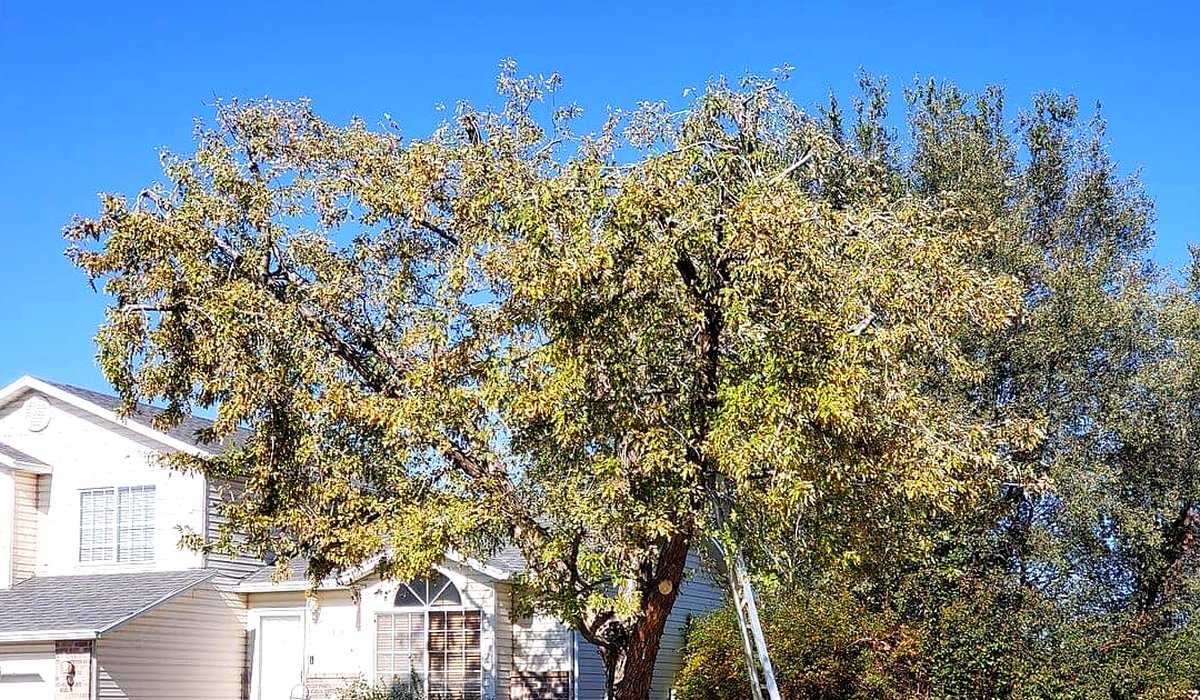
It is late summer in Fort Wayne or Marion, and you notice a branch hanging too low over the driveway. Or maybe a limb looks dead. Your instinct is to grab a saw and take care of it right now. But for most trees, summer is the worst possible time to make that cut. Here is why waiting a few months could save your tree years of trouble.
Trees Are Not Resting in Summer
When you look at a tree in full leaf during July or August, everything seems healthy and strong. But underneath that green canopy, the tree is working harder than at any other time of year. It is photosynthesizing, moving water and nutrients from roots to leaves, and producing the carbohydrates it needs to survive winter.
Every branch you remove during this period takes away leaves the tree is actively using. Purdue Extension's Tree Pruning Essentials guide (FNR-506-W) recommends late winter as the ideal pruning window for most deciduous trees because the tree is dormant and not depending on those branches for energy production.
Think of it this way: pruning in winter is like withdrawing money from a savings account. Pruning in summer is like taking money out of someone's paycheck before they have had a chance to deposit it. The tree loses both the branch and all the food that branch was producing.
Summer Wounds Heal Slowly
Trees do not heal the way people do. When you cut a branch, the tree cannot regrow the lost tissue. Instead, it walls off the wound through a process scientists call CODIT, or Compartmentalization of Decay in Trees. This was discovered by U.S. Forest Service pathologist Dr. Alex Shigo and is now the foundation of modern arboriculture.
Penn State Extension explains that when a tree is wounded, it creates chemical and physical barriers to prevent decay from spreading into healthy wood. The strongest of these barriers, called Wall IV, is formed by the cambium layer — the thin ring of tissue just under the bark that produces new wood.
Here is the problem with summer timing: wound closure depends on active cambial growth. In late winter and early spring, cambial growth is about to kick into high gear, so a pruning wound gets sealed quickly. By midsummer, that growth is slowing down. And by late summer, the cambium is preparing to shut down for dormancy. A wound made in August may sit open through fall and into winter with very little closure happening.
Disease and Insects Are Most Active in Summer
An open wound on a tree is an invitation. And in summer, every pest and pathogen that wants that invitation is wide awake.
Purdue Extension's guide on pruning ornamental trees and shrubs (HO-4-W) states that late winter or early spring is the optimum time to prune most plants because wounds heal quickly "without the threat of insect or disease infection." In summer, the opposite is true. Fungal spores are floating in warm, humid air. Bark beetles and borers are actively searching for stressed trees. Fresh pruning cuts release chemical signals that attract these insects.
Oak Wilt: A Case Study in Why Timing Matters
Oak wilt is one of the most devastating tree diseases in Indiana, and it is a perfect example of why summer pruning can be fatal. The disease is caused by the fungus Bretziella fagacearum and is spread by tiny sap-feeding beetles called nitidulid beetles.
Michigan State Extension warns that these beetles are most active from April through July. When you prune an oak tree during this window, the fresh wound attracts beetles that may be carrying oak wilt spores. The fungus enters through the wound, clogs the tree's vascular system, and can kill a red oak in a matter of weeks.
Purdue Extension's publication on oak wilt in Indiana (FNR-227-W) confirms that oak wilt has been found in most Indiana counties and is one of the most serious threats to oak trees in the Midwest. The recommendation is simple: do not prune oaks from April through October. The only safe pruning window is during winter dormancy, roughly November through March.
If an oak is damaged during summer by a storm, Michigan's Department of Natural Resources recommends covering the wound immediately with latex-based paint — one of the very few situations where wound paint is appropriate.
It Is Not Just Oaks
While oak wilt gets the most attention, other common Indiana trees also face specific summer pruning risks:
Elms. Dutch elm disease is spread by elm bark beetles, which are active during the growing season. The same logic applies: fresh pruning wounds in summer attract the beetles that carry the disease.
Maples, birches, and walnuts. Purdue Extension (HO-4-W) notes these species produce heavy sap flow in spring. They can be pruned in late winter, but the sap bleeding — while not harmful to the tree — bothers many homeowners. Pruning in midsummer avoids the bleeding, but it introduces all the other summer risks we have discussed.
Crabapples and other fruit trees. Fire blight, a bacterial disease, spreads rapidly in warm, wet conditions. Summer pruning of susceptible species can open pathways for infection. Iowa State Extension recommends pruning fruit trees during February and March when the disease is inactive.
What About Dead Branches?
Here is the one clear exception: dead wood can be removed at any time of year. A dead branch is no longer part of the tree's living system. It is not producing food, it is not connected to the vascular network, and removing it does not create a wound in living tissue.
Purdue Extension confirms that dead, damaged, or diseased branches can be removed whenever you spot them. In fact, removing dead wood promptly is good practice because it eliminates habitat for insects and prevents the branch from falling unpredictably.
The key word is dead. If you are not sure whether a branch is dead or alive, scratch the bark with your thumbnail. Living bark reveals green tissue underneath. Dead bark is brown and dry all the way through.
Late Summer Pruning Can Trigger Vulnerable New Growth
Iowa State Extension raises another concern about late summer and early fall pruning: it can stimulate a flush of new growth. Normally, trees begin hardening off in late summer — toughening their tissues and preparing for cold weather. A pruning cut in August or September can trick the tree into pushing out tender new shoots.
This new growth has not had time to harden before the first frost. When temperatures drop, those young shoots freeze and die, leaving the tree with yet another wound to compartmentalize. In northeast Indiana, where our first hard frost can arrive as early as mid-October, that does not leave much time.
So When Should You Prune?
For most deciduous trees in Fort Wayne and Marion, the answer is late winter — late February through early March. Iowa State Extension sums it up well: pruning during the late dormant season allows wound closure to begin as soon as spring growth starts, giving the tree the maximum time to recover.
Here is a quick reference:
Late winter (February–March): Best for most shade and ornamental trees. The tree is dormant, disease organisms are inactive, and wound closure begins immediately with spring growth.
After bloom (April–May): Best for spring-flowering trees like crabapple, magnolia, and redbud. Pruning before bloom removes flower buds. Wait until the flowers fade, then prune.
Any time: Dead, damaged, or hazardous branches. Do not wait on these.
Avoid: June through October for most species. This is the high-risk window for disease transmission, slow wound closure, and energy depletion.
Why This Matters for Your Trees
A bad pruning cut at the wrong time of year can set a tree back for decades. Decay fungi that enter through a summer wound do not just affect the branch — they can spread into the trunk, weakening the tree's structure from the inside out. Penn State Extension notes that once decay gets past the tree's compartmentalization barriers, it cannot be reversed. The tree lives with that damage for the rest of its life.
We see this across properties in Fort Wayne and Marion every year: trees that were pruned at the wrong time or in the wrong way, now showing cavities, dead sections, or structural cracks that trace back to a single bad cut. An arborist evaluation can identify these problems early, before they become safety hazards.
If you have a tree that needs attention, the best thing you can do right now is note the problem and plan for a late-winter pruning. And if you are not sure what you are looking at — whether a branch is dead or alive, whether a crack is structural or cosmetic, whether that fungus on the trunk is serious — give us a call at either our Fort Wayne or Marion office. Our certified arborist can take a look and help you make the right call at the right time.
Sources
- Purdue Extension FNR-506-W, "Tree Pruning Essentials"
- Purdue Extension HO-4-W, "Pruning Ornamental Trees and Shrubs"
- Purdue Extension, "Oak Wilt in Indiana"
- Penn State Extension, "Understanding the Spread of Decay in Trees"
- Michigan State Extension, "Stop Pruning Oak Trees Now to Avoid Oak Wilt"
- Iowa State Extension, "Proper Time to Prune Trees and Shrubs"