
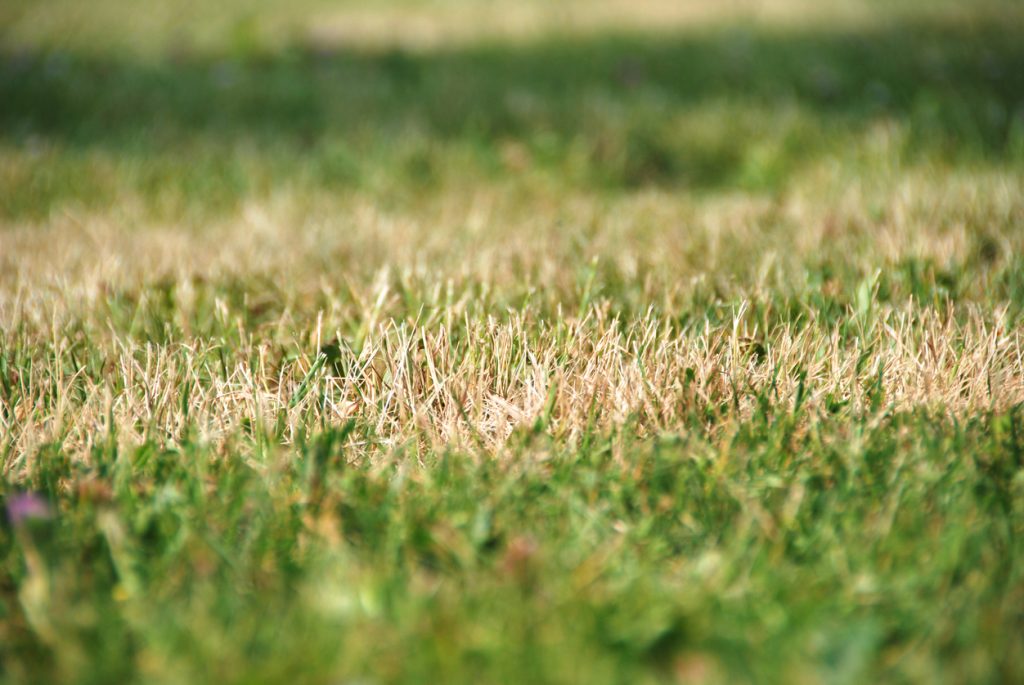
Every summer, it happens. Temperatures across Fort Wayne and Marion push into the 90s for a week straight, the rain stops, and lawns that looked great in May start turning brown by the Fourth of July. We see it on properties all over northeast Indiana. But here is the thing most homeowners do not realize: the biggest threat to your lawn during a heat wave is not the heat itself. It is how you respond to it.
What Heat Actually Does to Your Grass
The cool-season grasses that grow across northeast Indiana, mainly Kentucky bluegrass, tall fescue, and perennial ryegrass, are built for spring and fall. Purdue University Turfgrass Science explains that these grasses photosynthesize most efficiently between 60 and 77 degrees Fahrenheit. That is when they are growing the strongest, building root systems, and filling in thick.
Once air temperatures push past the mid-80s, the process starts to break down. Above roughly 87 degrees, cool-season grasses struggle to capture carbon dioxide from the air. Instead, they start capturing oxygen in a process called photorespiration, which essentially burns energy instead of producing it. The plant is running in reverse.
When this goes on for several days in a row, the grass slows its growth, closes its leaf pores to conserve water, and starts pulling resources back to the crown and root system. If conditions stay hot and dry long enough, the plant goes dormant. The blades turn brown, but the crown at the soil surface stays alive, waiting for cooler temperatures and moisture to return.
The Worst Thing You Can Do: Water on and Off
This is where most lawns get into trouble, and it is the mistake we correct most often on properties we manage across Fort Wayne and Marion.
Purdue's turfgrass researchers have found that cycling in and out of summer dormancy weakens cool-season turf more than either staying green with consistent irrigation or going fully dormant. When a lawn goes dormant and then gets a heavy rain or a burst of watering, it spends energy breaking dormancy and pushing new growth. If the heat and drought return a few days later, the plant has to shut back down again. Each cycle drains the reserves stored in the crown.
Think of it like waking someone up, making them sprint, and then telling them to go back to sleep. Over and over again all summer. The grass never fully rests and never fully recovers.
Iowa State Extension puts it simply: either commit to watering consistently through the summer or let the lawn go dormant. The in-between is the danger zone.
What Consistent Watering Actually Looks Like
If you want your lawn to stay green through an Indiana heat wave, the research is clear on what it takes. The baseline, all season long, is the D.I.E.T. method: about one inch of water per week, counting rain, delivered in one or two deep soakings. A heat wave is the exception that stretches that rule. Michigan State Extension recommends applying up to one and a half inches of water per week during hot, dry periods, split across two or three deep sessions. Still deep soakings, never daily light sprinkles.
Here is why that matters. Shallow, frequent watering keeps the root zone moist only at the surface. Roots have no reason to grow deep, so they stay in the top inch or two of soil, exactly where heat does the most damage. Deep, infrequent watering pushes moisture down six to eight inches, and roots follow.
Timing matters too. Michigan State recommends irrigating between sunrise and 10 a.m. Watering early lets the grass blades dry before evening, which reduces the risk of fungal diseases like brown patch and dollar spot that thrive in warm, wet conditions overnight.
Getting this right every week takes more attention than most homeowners expect. It is knowing how much water your system actually puts down, adjusting for rainfall, and watching for the early signs that your lawn needs more or less. The watering itself is in your hands. What our summer program does is time treatments around the heat, and when we are on your property, we will tell you straight out if your watering is working against you. And on any given morning, our free Should I Water Today? tool gives you the answer for your ZIP code.
If Your Lawn Goes Dormant, It Is Not Dead
Here is some good news. If your lawn has already turned brown, it is almost certainly dormant, not dead. Ohio State University turfgrass researchers note that Kentucky bluegrass can survive four to six weeks of drought dormancy thanks to its rhizome system. Those underground stems store enough energy to regrow once conditions improve.
Tall fescue is a bit more vulnerable since it grows in bunches rather than spreading by rhizomes, but it still has solid drought tolerance if it was healthy going into summer.
The key is not to panic and not to force it out of dormancy unless you are ready to keep watering consistently. If you decide to let the lawn rest, Michigan State recommends applying about a half inch of water every two to three weeks. That is not enough to green it up, but it keeps the crowns hydrated so the plant survives until temperatures cool and rain returns in late August or September.
Raise Your Mowing Height
One of the simplest things that makes a real difference in summer is mowing height. Purdue Extension's Maintenance Calendar for Indiana Lawns (AY-27-W) recommends mowing at 2.5 to 3.5 inches through the summer season. Iowa State Extension goes further, recommending 3 to 3.5 inches specifically during hot weather.
Taller grass shades the soil surface, which keeps soil temperatures lower and reduces water evaporation. It also means more leaf surface for the plant to capture sunlight, even when the process is less efficient in the heat. Research from Purdue shows that taller turf can reduce soil surface temperatures by up to 15 degrees compared to a closely mowed lawn.
Raising your cutting height as summer progresses is a small change that makes a measurable difference in how the lawn handles heat stress. Across the properties we treat in Fort Wayne and Marion, the lawns kept a little taller through the heat are consistently the ones that hold up best.
One more thing about mowing in the heat: Iowa State recommends mowing in the cooler parts of the day, either morning or evening. Cutting grass at midday when temperatures are at their peak adds stress on top of stress. And as always, a sharp blade matters. Dull mower blades tear the grass instead of cutting it, leaving ragged tips that lose water faster and invite disease.
What We Watch for in Summer
Heat stress does not just make lawns brown. It opens the door to other problems that can cause real, lasting damage.
Fungal diseases. Brown patch, dollar spot, and pythium blight all thrive in hot, humid conditions. We see these across Fort Wayne and Marion every July. The symptoms can look a lot like drought stress, but the treatment is completely different. Misdiagnosing drought for disease, or vice versa, wastes time and money.
Insect pressure. Purdue's maintenance calendar (AY-27-W) recommends scouting for white grubs starting in summer. Grub damage often shows up as brown patches that peel back like carpet, and it gets worse in late summer and fall if left untreated. Our grub prevention program targets the window before damage becomes visible.
Weed invasion. Thin, stressed turf is an open invitation for summer weeds. Crabgrass, nutsedge, and spurge all move into bare or weak spots left behind by heat damage. A thick, well-maintained lawn is the best defense, which is why everything we do in spring and summer builds toward keeping that canopy dense.
The Fall Payoff
Here is what we tell homeowners every summer: how your lawn looks in July is temporary. How it comes back in September depends on what you did, or did not do, during the heat.
Lawns that were properly managed through the summer, whether they stayed green with consistent watering or went dormant cleanly, bounce back strong once temperatures drop into the 60s and 70s in early fall. That is when cool-season grasses hit their second growth surge, filling in thin spots and building the root mass that carries them through winter.
Lawns that were stressed by inconsistent watering or scalped by a low mower often struggle into fall. They come back thin, patchy, and full of weeds, needing aeration, overseeding, and extra fertilizer rounds just to get back to where they started.
Our programs are built around this cycle. Everything we do in summer, from timing treatments around the weather to watching for disease and insect pressure, is designed to set up the strongest possible fall recovery. If your lawn is struggling this summer, the sooner we get involved, the better the outcome in September.