If you could only do one thing for your lawn this fall, it should be core aeration. We say that to homeowners across Fort Wayne and Marion every September and October, and the research backs it up. Purdue Extension calls aeration one of the most important cultural practices for maintaining a healthy lawn. Here is why it matters so much and why right now is the time.
Your Soil Is Working Against Your Grass
Think about everything your lawn goes through in a single year. Kids running across it. Dogs wearing paths along the fence line. Mowers rolling over it every week from April through October. Rain pounding down on it all summer.
All of that traffic presses the soil particles closer together. Over time, the soil gets packed down so tight that water, air, and nutrients can barely reach the roots. Turf scientists call this compaction, and it is one of the most common problems we see in Northeast Indiana lawns.
Purdue Extension's guide on aerifying (AY-8-W) explains that compacted soil restricts root growth, reduces water infiltration, and creates conditions where thatch builds up faster. Michigan State Extension adds that compacted soil forces grass roots to stay shallow, which makes the lawn more vulnerable to heat, drought, and disease.
The trouble is, you cannot see compaction. Your lawn might look fine on top while the roots are struggling underneath. The signs show up gradually: thin spots that do not fill in, puddles after a light rain, bare patches that keep coming back no matter what you do.
What Core Aeration Actually Does
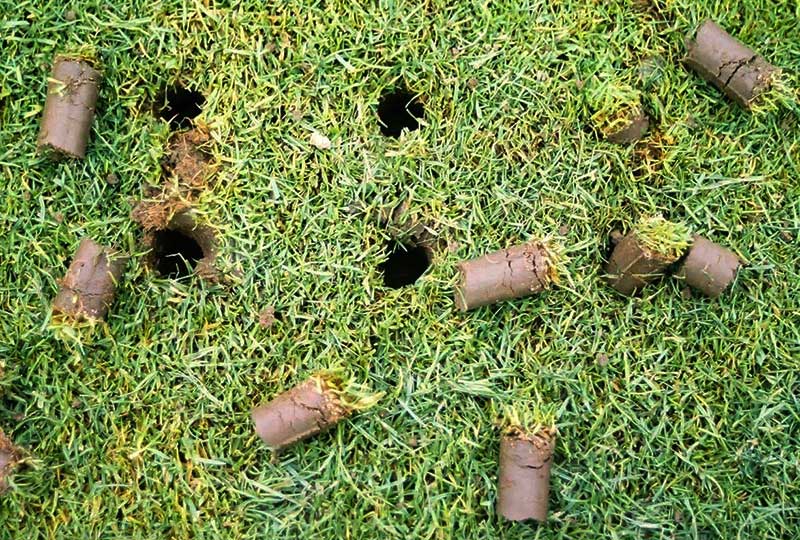
Core aeration is simple in concept. A machine pulls small plugs of soil out of the ground, about two to three inches deep, and deposits them on the surface. Those plugs are the little cylinders you see scattered across the lawn afterward.
What this does underground is the important part. Those holes give the soil room to loosen up. Water starts soaking in instead of running off. Air reaches the root zone. Nutrients from fertilizer applications actually get where they need to go instead of sitting on top of a hard surface.
Purdue Extension notes that the soil plugs left on the surface break down within a couple of weeks and help decompose the thatch layer as they work back into the turf. So those plugs that look messy for a few days are actually doing your lawn a favor.
Iowa State Extension research confirms that core aeration significantly improves water infiltration in compacted soils. That is a big deal when you consider how many lawns in Fort Wayne and Marion sit on heavy clay soil that does not drain well to begin with.
Why Fall Is the Window
You might wonder why we do not just aerate in the spring. Here is the reason: timing has to work with the grass, not against it.
Kentucky bluegrass, tall fescue, and perennial ryegrass are all cool-season grasses. That means they do most of their growing when temperatures are between 60 and 75 degrees. In Northeast Indiana, that window lines up with September and October.
When you aerate during this active growth period, the grass fills in those holes quickly. New roots push into the loosened soil. The plant is in its strongest growth phase and recovers fast. Purdue's Maintenance Calendar for Indiana Lawns (AY-27-W) lists fall as the recommended window for core aeration of cool-season turf.
Spring aeration is a different story. Aerating in April or May opens up bare soil right when crabgrass and other summer annual weeds are trying to germinate. You are essentially rolling out the welcome mat for the weeds you spent all spring trying to prevent. Michigan State Extension specifically cautions against spring aeration for this reason.
Ohio State Extension agrees, noting that fall aeration avoids disrupting pre-emergent herbicide barriers and takes advantage of the natural recovery period for cool-season grasses.
Compaction Is Worse Than You Think
Most homeowners underestimate how much compaction affects their lawn. Here is what the research shows it does:
Shallow roots. When soil is packed tight, roots cannot push down. They stay in the top inch or two. That means the grass has almost no reserves when summer heat or drought hits. Purdue Extension notes that a healthy Kentucky bluegrass lawn should have roots reaching six inches or deeper.
Poor drainage. Compacted soil cannot absorb water efficiently. After a rain, water pools on the surface instead of soaking in. That standing water suffocates grass roots and creates perfect conditions for fungal disease.
Thatch buildup. Purdue's AY-8-W explains that compacted soil slows down the microbial activity that naturally breaks down thatch. So the dead grass tissue builds up faster than it decomposes, creating a spongy layer that blocks water and air even more.
Wasted fertilizer. When your soil is compacted, a large portion of what gets applied to the surface never reaches the roots. It either runs off with rainwater or sits in the thatch. Aeration makes every treatment we apply work harder because it can actually reach the root zone.
Aeration and Overseeding: The One-Two Punch
One of the biggest advantages of fall aeration is what it sets up next: overseeding.
Those holes in the soil create perfect seed-to-soil contact. When we overseed right after aerating, the grass seed drops into those openings where it stays moist, protected, and in direct contact with the soil. That is exactly what seed needs to germinate.
Purdue Extension recommends pairing aeration with overseeding in the fall for lawns that have thinned out over the summer. The combination thickens the turf, introduces newer grass varieties, and fills in bare spots before winter.
A thick, dense lawn is also your best defense against weeds. Every square inch of turf that fills in this fall is one less opening for crabgrass to exploit next spring. Michigan State Extension calls a dense, healthy lawn the single most effective weed control strategy.
This Is Not a DIY Job
You can rent a core aerator from an equipment rental shop. But there is a reason most homeowners only do it once before calling a professional.
Commercial core aerators are heavy, difficult to maneuver, and hard on the body. A rental machine often does not pull plugs as deep or as consistently as commercial-grade equipment. The machines we run across Fort Wayne and Marion are built to pull uniform plugs at the right depth and spacing, which is what the research says matters for results.
There is also the timing factor. We know when soil moisture conditions are right for aeration in this area. Too dry and the tines bounce off the surface. Too wet and the holes smear closed. Getting it right makes the difference between aeration that transforms your lawn and aeration that just leaves a mess.
What to Expect After We Aerate
After we aerate your lawn, you will see small soil plugs scattered across the grass. They look a little rough for a week or two, but resist the urge to rake them up. Those plugs break down on their own and return nutrients and microorganisms to the surface.
Within two to three weeks, you will start to see the difference. The grass fills in around the holes. Water soaks in faster after rain. If we overseeded, you will see new grass seedlings emerging in the aeration holes.
By spring, the lawn you aerated this fall will be noticeably thicker, greener, and more resilient than it was this summer. That is the payoff for getting this done now, while the window is open.
The Window Is Open Right Now
In Fort Wayne and Marion, the ideal aeration window runs from mid-September through mid-October. Once the ground gets too cold or too wet, the opportunity is gone until next fall.
If your lawn dealt with any heat stress, brown spots, or thinning this summer, aeration is the single best step you can take before winter. And if your lawn looked great all year, aeration keeps it that way by preventing the slow creep of compaction that undermines even healthy turf.
Our team is running aeration and overseeding programs across Fort Wayne and Marion right now. If you have been thinking about it, this is the time.