
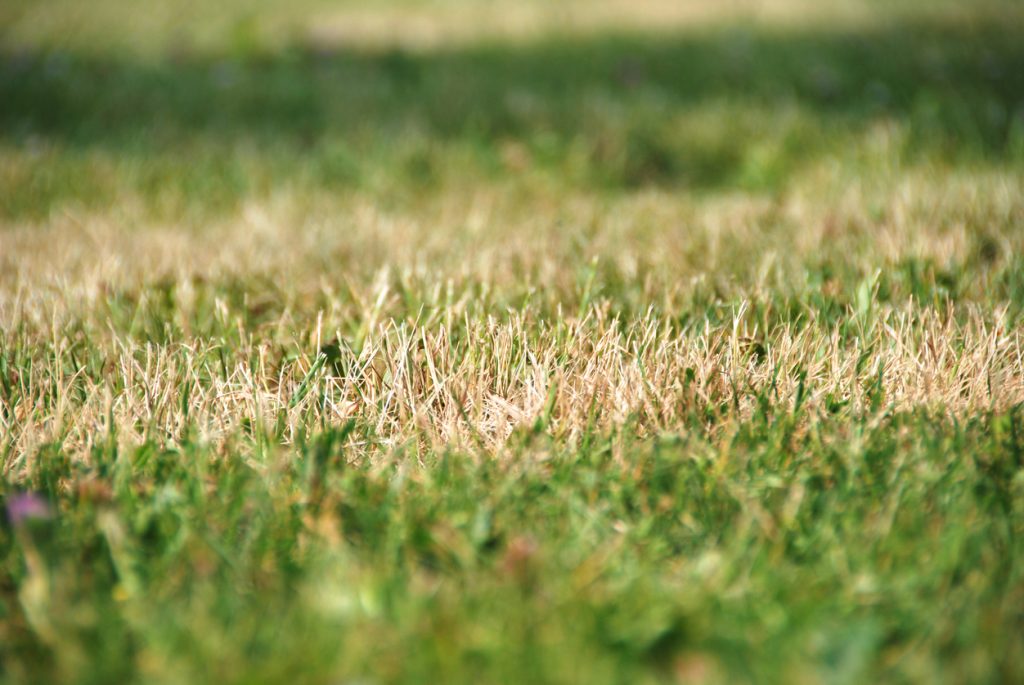
You walk outside one morning and your lawn has brown spots that were not there last week. Your first instinct is probably to grab the hose. But here is the thing: watering is only the right answer about a third of the time. Brown spots can come from drought, disease, or insects — and treating for the wrong cause does not just waste time. It can actually make the problem worse.
Why Getting the Diagnosis Right Matters
Brown spots are a symptom, not a diagnosis. Just like a fever could mean a cold or something more serious, a brown patch in your lawn could point to three very different problems. And each one calls for a different response.
Here is the catch: watering a lawn that has a fungal disease feeds the fungus. Fertilizing a lawn with brown patch makes the disease spread faster. And waiting out what you think is drought stress when grubs are actually eating your roots means the damage gets worse every day.
Purdue Extension’s turfgrass disease profile series (BP-124-W) explains that lawn diseases need three things to develop: a susceptible grass, a pathogen, and the right weather conditions. They call it the disease triangle. Take away any one of those three and the disease cannot take hold. That concept applies here too — you need to know what you are dealing with before you can fix it.
We see all three causes across Fort Wayne and Marion every late summer. And more often than you might think, what looks like drought is actually disease, or what looks like disease is actually insects. Let us walk through each one.
Cause #1: Drought Stress
This is the most common reason lawns turn brown in July, August, and September. Cool-season grasses like Kentucky bluegrass and tall fescue — the grasses that make up most lawns in northeast Indiana — are built for temperatures between 60 and 75 degrees. When it stays above 85 for days on end with little rain, they shut down.
Purdue Extension’s Maintenance Calendar for Indiana Lawns (AY-27-W) describes this as summer dormancy. The grass is not dead. It is conserving energy by pulling resources away from the leaf blades and protecting its crown and root system underground. The blades turn tan or straw-colored, but the plant is still alive.
What drought stress looks like
Large, uniform areas of browning. Drought stress does not usually show up in neat circles. It spreads across open, sunny sections of the yard — especially south-facing slopes, areas near pavement that absorb heat, and spots where soil is thin or compacted.
Footprints that linger. Walk across the brown area. If your footprints stay visible for more than a few seconds, the grass blades have lost their turgor pressure and cannot spring back. That is a classic drought signal.
Hard, dry soil. Push a screwdriver into the ground. If you can barely get it in, the soil is bone dry and your lawn is thirsty.
The good news
Dormant grass usually comes back on its own once cooler weather and rain return in fall. Extension research across the Midwest suggests that cool-season lawns can survive up to about six weeks of dormancy before crown damage starts to set in. If your lawn went brown in mid-August and it is now September, the recovery window is still open.
If you are watering, the key is doing it right — deep and infrequent, not a little bit every day. Our free watering tool can tell you whether your lawn needs water today based on your local conditions.
Cause #2: Fungal Disease
This is the one that catches people off guard. Your lawn was green, you have been watering, and suddenly there are brown patches that look nothing like the uniform browning of drought. Welcome to fungal disease season.
The most common culprit in northeast Indiana is brown patch, caused by the fungus Rhizoctonia solani. Purdue Extension’s Turfgrass Disease Profile (BP-106-W) identifies it as a foliar disease — it attacks the leaf blades but typically does not kill the crown or roots, which means recovery is possible if you catch it early.
What brown patch disease looks like
Circular or roughly circular patches. They can range from a few inches to several feet across. The shape alone is a strong clue that you are dealing with disease, not drought.
A darker ring around the edge. In the early morning when dew is still on the grass, you may notice a grayish or dark brown border around the patch. Turf scientists call this the “smoke ring.” It is the active edge of the fungus and one of the most reliable visual signs of brown patch.
Grass blades that look water-soaked. Pull a blade from the edge of the patch and look at it closely. If it looks dark, slimy, or water-soaked at the base, that is fungal damage.
When it strikes
Brown patch explodes when nighttime temperatures stay above 65 to 68 degrees and humidity is high. Purdue Extension’s guide to seasonal turfgrass pathogen activity (BP-125-W) shows that brown patch peaks from late June through September in Indiana — exactly the window we are in right now.
Here is the important part: too much water and too much nitrogen fertilizer are the two biggest accelerators. If you see circular brown patches and your first move is to water more and fertilize, you just gave the fungus exactly what it needs to spread.
Other diseases to know
Brown patch is the most common, but dollar spot and red thread also show up in our area. Dollar spot creates small, silver-dollar-sized straw-colored spots that can merge into larger areas. Red thread produces pinkish-red strands on the leaf tips. We covered all three in detail in our lawn disease identification post.
Cause #3: Insect Damage
This is the sneakiest cause because the damage often looks like drought at first. You see brown patches that do not respond to watering, so you water more. Nothing changes. The reason is that something underground is eating the roots — no amount of water helps when the delivery system is gone.
Grubs
White grubs are the larvae of beetles — Japanese beetles, masked chafers, and others. They live in the soil and feed on grass roots. Purdue Extension (E-271-W) describes the damage pattern: irregular brown patches that feel spongy underfoot and do not bounce back with watering.
The tell is what we call the tug test. Grab a handful of brown grass and pull. If it peels up like loose carpet with little resistance, the roots have been chewed away. Healthy grass, even brown dormant grass, holds tight because the roots are intact.
September is peak grub damage season in Fort Wayne and Marion. The grubs hatched from eggs laid in July and August, and by now they are large enough to do real damage. Purdue Extension notes that healthy turf can tolerate around 8 to 10 grubs per square foot. Above that threshold, visible damage appears.
Chinch bugs
Chinch bugs are tiny — about the size of a pencil tip — but they can destroy large sections of lawn. They pierce grass blades, suck out the sap, and inject a toxin that kills the plant. The damage shows up as irregular patches of dead, straw-colored grass, usually in the sunniest, hottest parts of the yard — near driveways, sidewalks, and south-facing areas.
Michigan State Extension points out that chinch bug damage is easily mistaken for drought stress because it tends to appear in the same hot, dry conditions. The difference is that watering does not help, and the brown area keeps expanding outward even when the rest of the lawn greens back up after rain.
We covered chinch bugs in depth in our chinch bug post if you want the full breakdown.
A Quick Diagnostic Guide
Here is how to narrow down what is going on in your lawn:
Is the browning uniform across large sunny areas? Probably drought stress. Check the soil moisture and try the footprint test.
Are the patches circular with a darker border? That points to fungal disease, most likely brown patch. Look for the smoke ring in the morning dew.
Does the brown grass pull up easily like carpet? That is the tug test, and it points to grub damage. Flip the turf over and look for C-shaped white grubs in the soil.
Are the brown patches in the hottest spots near pavement, and they keep spreading even after rain? Think chinch bugs.
Did the browning appear overnight after a stretch of hot, humid nights? That is textbook brown patch disease timing.
Has it been dry for weeks and the whole lawn looks tired? Drought dormancy. The lawn will likely come back on its own this fall.
Why the Wrong Fix Makes Things Worse
This is the part we really want you to take away from this post. Each of these three problems has a different solution, and the solutions can conflict with each other.
If your lawn has brown patch disease and you water more, you are extending the leaf wetness period that the fungus needs to grow. If you fertilize to try to “push the lawn through it,” the extra nitrogen feeds the disease. Purdue’s disease profiles are clear on this: excess nitrogen is one of the primary drivers of brown patch severity.
If your lawn has grubs and you assume it is drought, you are losing time. Grub damage in September means the prevention window has already passed for this year. But identifying the problem now means we can build a preventive plan for next summer, timed to early June before the eggs hatch.
And if your lawn is simply dormant from drought, the best move might be to do nothing at all. Dormant grass recovers naturally when conditions improve. Overreacting with heavy watering, fertilizer, and treatments can stress the lawn further.
When to Call Us
If your lawn has brown spots and you are not sure what you are looking at, that is exactly when a professional diagnosis makes a difference. Our team sees these problems every day across Fort Wayne and Marion. We know what brown patch looks like versus drought versus grubs because we are out on properties dealing with all three, often in the same week.
Our lawn disease and insect program covers the full range — fungal disease treatment, grub control, and chinch bug management. And because we are already on a regular schedule with our lawn care customers, we often catch these problems before they spread. That early identification is the single biggest advantage of having a professional team on your property.
A brown spot caught early is a small fix. A brown spot left to spread for weeks can mean a much bigger recovery project come fall.
Sources
- Purdue Extension AY-27-W, “Maintenance Calendar for Indiana Lawns” — Link
- Purdue Extension BP-106-W, “Turfgrass Disease Profiles: Brown Patch” — Link
- Purdue Extension BP-124-W, “Identifying Turf Diseases” — Link
- Purdue Extension BP-125-W, “Seasonal Activity of Turfgrass Pathogens in the Midwest” — Link
- Purdue Extension E-271-W, “Turfgrass Insects: Managing White Grubs in Turfgrass” — Link
- Michigan State Extension, “How to Choose and When to Apply Grub Control Products for Your Lawn” — Link