
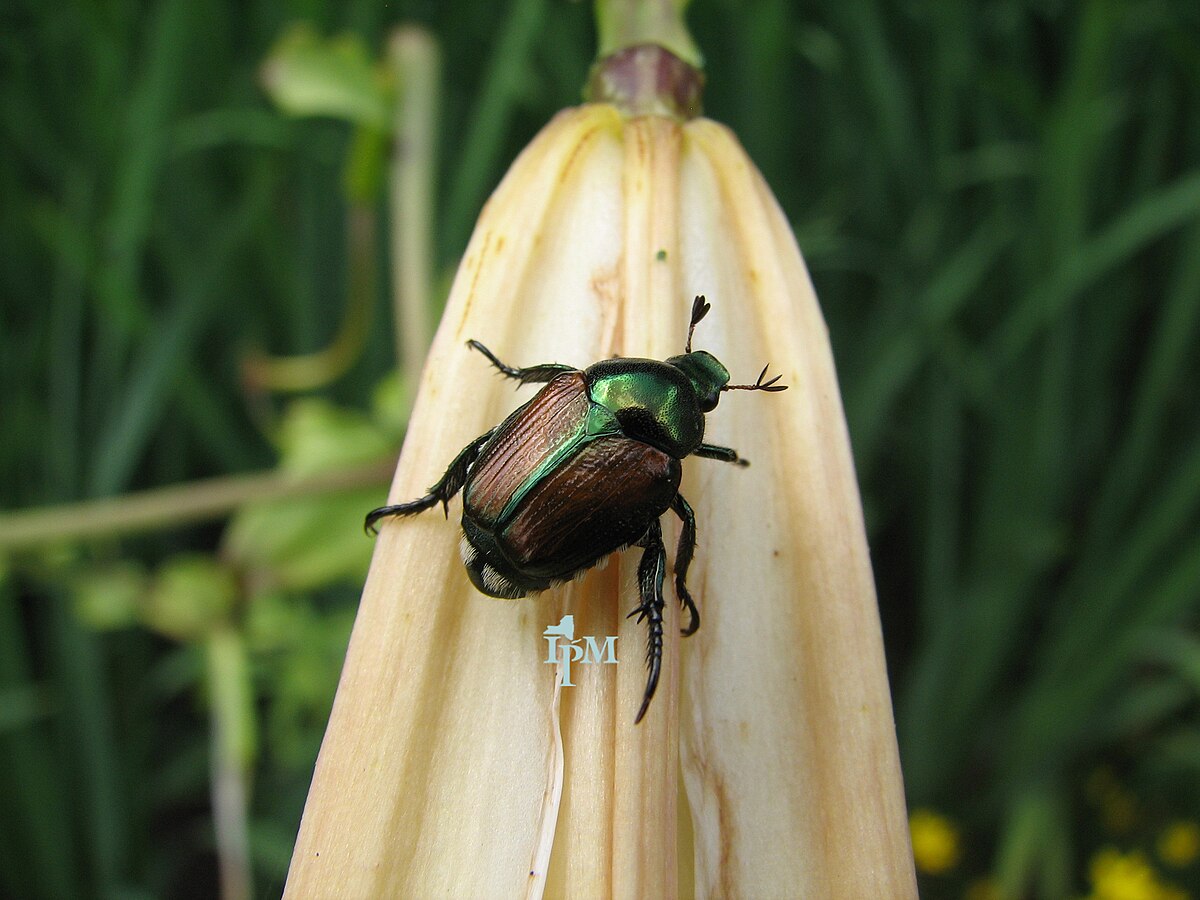
Every summer, we get calls from homeowners across Fort Wayne and Marion who are frustrated. Their lawn looked fine in June. By August, brown patches appeared out of nowhere. The grass feels spongy underfoot. In the worst spots, you can peel back the turf like a loose carpet. The culprit is almost always the same: white grubs feeding on the roots just below the surface.
What Are White Grubs?
White grubs are the larval stage of several beetle species. In northeast Indiana, the most common are Japanese beetles, masked chafers, and European chafers. The adults look different — Japanese beetles have that unmistakable metallic green and copper shell you see in the photo above — but their larvae all look nearly identical.
Picture a plump, C-shaped, creamy white worm with a brown head, curled up in the soil an inch or two below the surface. That is a white grub. Purdue Extension describes these larvae as some of the most destructive turf pests in Indiana. They feed on grass roots, severing the connection between the plant and the soil. When enough of them gather in one area, the grass above simply dies.
The Lifecycle That Drives Everything
Understanding grubs means understanding their lifecycle. Timing is the entire game when it comes to managing them, and the biology explains why.
Adult beetles emerge from the soil in late June and July. Japanese beetles are the easiest to spot — they swarm roses, lindens, and other landscape plants, skeletonizing the leaves in broad daylight. Masked chafers are sneakier. They fly at dusk and are drawn to lights, so you may never notice them.
While the adults are feeding above ground, the females are also laying eggs in the soil. They prefer moist, well-maintained lawns — exactly the kind of yards homeowners work hardest to keep nice. According to Purdue Extension, a single female Japanese beetle can lay 40 to 60 eggs over her lifetime.
Those eggs hatch in late July and August. The tiny grubs immediately start feeding on grass roots. They eat through August, September, and into October, growing through three larval stages called instars. This late-summer feeding period is when the real damage happens.
As soil temperatures drop in late fall, the grubs burrow deeper — sometimes 8 to 12 inches down — to overwinter. When the soil warms again in spring, they move back up to the root zone for a brief feeding period before pupating into adults. By June, the new beetles emerge, and the whole cycle starts over.
Michigan State Extension notes that this one-year lifecycle is typical for Japanese beetles and masked chafers across the Great Lakes region. The timing shifts a week or two depending on the year's weather, but the pattern is remarkably consistent.
Why Indiana Lawns Are Prime Targets
Northeast Indiana checks every box for grub problems. Our cool-season grasses — Kentucky bluegrass, tall fescue, perennial ryegrass — provide exactly the root system grubs prefer. Our clay-heavy soils hold moisture, which beetles seek out for egg-laying. And our summers are warm enough for the beetles to complete their lifecycle but cool enough that the grubs thrive.
Purdue Extension points out that irrigated lawns are especially attractive to egg-laying beetles. Lawns watered regularly through July stay moist at the soil surface, which is exactly what the females are looking for. It is one of those frustrating situations where taking good care of your lawn can actually make it more vulnerable.
What Grub Damage Looks Like
Grub damage typically shows up in late August and September, right when the larvae are at their largest and hungriest. Here is what we see on properties across Fort Wayne and Marion every year:
Brown patches that do not respond to watering. The grass is not drought-stressed. The roots are gone. No amount of water will fix that.
Turf that feels spongy or loose. Walk across a damaged area and it feels like stepping on a thick mat. In severe cases, you can grab a handful of grass and peel it right back. Underneath, you will find the grubs curled up in the soil.
Animals tearing up your lawn. Skunks, raccoons, and crows will rip apart a grub-infested lawn to get at the larvae. If you wake up to chunks of turf flipped over, something is digging for grubs. Moles tunnel through for the same reason — they are following the food source underground.
Ohio State Extension notes that damage is often patchy because grubs are not evenly distributed. They tend to cluster in sunny, well-watered areas. That is why you might see damage in the front yard but not the back, or along the edges of an irrigated zone but not in the dry spots.
Purdue Extension states that healthy lawns can typically tolerate up to about 8 to 10 grubs per square foot before visible damage appears. Stressed or thin lawns show damage at lower counts.
Why Timing Is the Whole Game
Here is the part that catches most homeowners off guard: by the time you see grub damage in August and September, the best treatment window has already passed.
Preventive grub control is applied in June or early July, before the eggs hatch. The treatment sits in the soil, ready to target the tiny, newly hatched grubs as they begin feeding. At that stage, the larvae are small and vulnerable. This is the window with the highest success rate, and it is the approach Purdue Extension recommends for lawns with a history of grub damage.
Once grubs reach full size — the fat, third-instar larvae feeding heavily in late August — they are much harder to control. Curative options exist, but they are less consistent and only work when grubs are still actively feeding near the surface. By October, the grubs have burrowed deep into the soil, and treatment becomes unreliable.
Michigan State Extension's turfgrass research reinforces this: preventive applications timed to early summer consistently outperform reactive treatments made after damage appears. The difference in effectiveness is not small.
This is why we start talking to customers about grub prevention in May and June — not because we are trying to sell something early, but because the biology of the pest demands it. Wait until the damage shows up, and you are already a month too late for the most effective approach.
What Happens If You Skip Prevention
Grub damage does not always fix itself. If the root system is destroyed, the grass in those areas is dead. It will not grow back on its own. Those bare patches become an open invitation for weeds, especially in fall when crabgrass is dropping seeds and broadleaf weeds are establishing.
A lawn that had moderate grub damage in August often looks even worse the following spring. The dead patches are still there, now mixed with whatever weeds moved in. And if the grub population was not addressed, the cycle repeats with a new generation of beetles laying eggs the following July.
We see this pattern on properties that come to us after a bad grub year. The lawn needs both prevention for the current season and recovery work — overseeding, sometimes aeration — to fill back in the areas that were lost. It is fixable, but it costs more time and money than preventing the damage in the first place.
Why This Belongs in a Lawn Care Program
Grub prevention is not complicated in theory. The tricky part is execution: the right product, applied at the right rate, at the right time, with professional equipment, to the right areas of the lawn. Every one of those variables matters.
The treatment window is narrow. Apply too early and the product can break down before the eggs hatch. Apply too late and the grubs are already too large. Our team tracks soil temperatures and beetle flight activity across Fort Wayne and Marion so that applications go out during the optimal window — not just whenever the schedule allows.
This is one of the treatments we build into our lawn insect and disease program because it works best as a planned, preventive application rather than a reactive scramble after damage appears. If grubs have been a problem on your property before, or if your neighbors have dealt with them, it is worth having that conversation with us before the beetles start flying in June.
Sources
- Purdue Extension E-271-W, "Turfgrass Insects: Managing White Grubs in Turfgrass" — Link
- Purdue Extension E-75-W, "Japanese Beetles in the Urban Landscape" — Link
- Michigan State Extension, "How to Choose and When to Apply Grub Control Products for Your Lawn" — Link
- Ohio State Extension HYG-2510, "Identification of White Grubs in Turfgrass" — Link