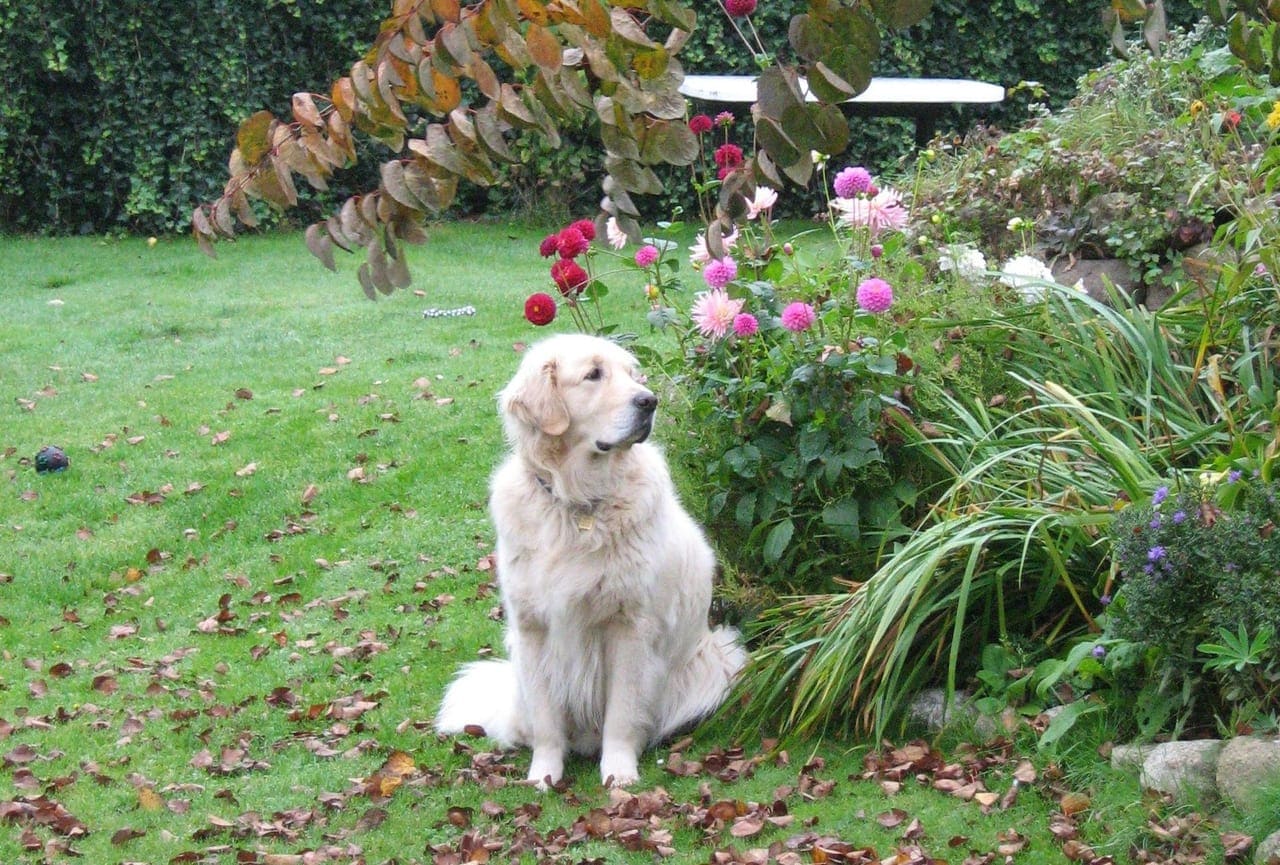
It is the question we hear most in Fort Wayne and Marion: "After you treat my lawn, when is it safe for my kids and my dog to go back outside?" That is a fair question, and you deserve a real answer. So let's talk about it. This is not about the moment we are spraying — just pretend nobody is outside while we work. This is about what is left on your grass after we finish, and how much it should really worry you. The short version: a lot less than you might think.
Those Scary Words on the Label
Look at a jug of lawn product and you will see one of three words: DANGER, WARNING, or CAUTION. The EPA makes every product carry one of these. They are called "signal words." Here is what they mean, based on the National Pesticide Information Center (NPIC), a group run by Oregon State University and the U.S. EPA:
CAUTION means the product is only "slightly toxic." This is the safest level.
WARNING means it is "moderately toxic" — the middle level.
DANGER means it is "highly toxic by at least one route" — the strongest level.
Now here is the part almost nobody tells you: that word is about the full-strength concentrate inside the jug — the version that lives at our shop, before anything is mixed. It is really a warning for the person handling and mixing that concentrate. It is not a grade for the thin, dried layer left on your grass after the product has been mixed with water, sprayed, and dried. In fact, the concentrate never comes anywhere near your property. We mix it down into a much weaker spray back at our shop, before we ever load the truck.
Why a "DANGER" Jug Doesn't Mean a Dangerous Lawn
Let's slow down here, because this matters. A product gets its signal word from its worst score on any single test. As NPIC says, "The study that shows the highest toxicity is used to determine the signal word." One bad score sets the label.
Take the three-way weed killer (a mix of 2,4-D, mecoprop, and dicamba) that we use on tough weeds. Many of these jugs say DANGER. But look closely — they do not have the skull-and-crossbones "POISON" symbol. That is a big deal. Penn State Extension explains it this way: "Some pesticide products have the signal word DANGER without the skull and crossbones symbol because possible skin and eye effects are more severe than suggested by the acute toxicity of the product." In plain words: the DANGER is there because the full-strength concentrate could hurt your eyes if it splashed in them while someone was handling it. It is not there because it would poison you to swallow a little. The skull-and-crossbones — the one that means even a tiny amount could kill you — shows up only on the most toxic products. The ones we use do not have it.
So that DANGER on the jug is about the concentrate in the bottle — which we have already mixed down into a far weaker spray before we ever pull up to your house — not about your dog walking across the dry, diluted mix on your lawn once it has dried. Two other products we use prove the point: the pre-emergent we use for crabgrass (prodiamine) and the insecticide we use for fleas, ticks, and other pests (bifenthrin) both carry the safest word, CAUTION.
What Is Actually Left on Your Grass
After we spray, what stays behind is a very small amount of the weed or bug killer. It has been mixed with a lot of water, spread thin over the whole yard, and dried onto the grass. Once you see how little is there — and how mild it is — the worry gets a lot smaller.
Look at the 2,4-D in our three-way weed killer. NPIC says "all chemical forms for 2,4-D are considered low in toxicity" if swallowed, and low to very low if breathed in. Triclopyr, another weed killer we use on stubborn weeds, is also low in toxicity by mouth, on the skin, and in the air. And the bug killer, bifenthrin, is — in NPIC's own words — "more toxic to insects than it is to people because insects have lower body temperatures and smaller body size." It is made to work on bugs, not on your family.
This does not mean you should be careless with lawn products. It means the bit left on the grass, once dry, is at the low end of the toxicity scale — not the scary high end the word DANGER might make you picture.
The One Rule That Really Matters: Wait Until It's Dry
If you remember just one thing, remember this. The labels say to keep people and pets off the lawn until the spray has dried. (For granular products, like some pre-emergents and grub controls, you water them in and let the lawn dry again.)
The reason is simple. While it is wet, the product can rub off onto skin, fur, or bare feet. Once it dries, the liquid is gone and what is left sticks to the grass — there is very little to rub off. Drying usually happens fast — often in under an hour, and even quicker on a sunny, breezy day. That short wait is the whole safety step. We make sure every customer knows about it before we leave.
So — Is It Safe for Kids, Pets, and Adults?
Once the lawn is dry, the risk to the people and pets living on it is low. These products are mild to mammals, the amount left is tiny, and the wet stage has passed. For triclopyr, NPIC says plainly that "there is no evidence to suggest that children are more sensitive to triclopyr than adults."
How Does This Compare to What's Under Your Kitchen Sink?
Here is some perspective most people never get. Scientists measure how toxic something is with a number called the LD50. It is written in milligrams per kilogram, or "mg/kg." That is how many milligrams of the stuff it would take, for each kilogram (about 2.2 pounds) that a body weighs, to be a deadly dose in animal testing. The easy way to think about it: "how much it would take to be dangerous." A small number means even a little is harmful. A big number means you would need a whole lot before it became a problem.
That leads to the part people find backwards at first: a bigger LD50 number means the product is SAFER, not more dangerous. The more it takes to cause harm, the safer the thing is. So as you read down the chart below, the numbers get bigger — which means each item is safer than the one above it.
To put that in perspective, we looked up the LD50 for the weed-control ingredients we use — the three in our three-way product, the triclopyr for tough weeds, and the prodiamine that stops crabgrass — plus the urea in our fertilizer, and lined them up against a plain aspirin and caffeine. One thing matters before you read it: every number here, ours included, is for the pure ingredient. That is simply how toxicity is measured. Here is how the pure ingredients stack up:
⬇ As you go down the list, the number gets bigger — and bigger means SAFER ⬇
| Substance | Where you find it | LD50 in mg/kg (bigger = safer) | How safe vs. a plain aspirin? |
|---|---|---|---|
| Caffeine | A cup of coffee | ~192 | About the same as aspirin |
| Aspirin | Your medicine cabinet | ~200 | This is our yardstick |
| 2,4-D | Three-way weed control | 375–666 | About 2× safer |
| Mecoprop (MCPP) | Three-way weed control | ~414 | About 2× safer |
| Triclopyr | Tough-weed control | 630–729 | About 3× safer |
| Dicamba | Three-way weed control | 757–1,707 | About 4× safer |
| Prodiamine | Crabgrass pre-emergent | >5,000 | About 25× safer |
| Urea | Our lawn fertilizer | ~8,471 | About 42× safer |
Look at that chart again, because it is the part almost no homeowner ever hears: pound for pound, every weed-killer ingredient we put on your lawn is less toxic than a plain aspirin — and aspirin is something people swallow on purpose for a headache. That is a fair, head-to-head match, because an aspirin tablet really is a concentrated dose of its active ingredient. The urea in our fertilizer is milder still — dozens of times safer than aspirin.
Caffeine sits right next to aspirin on the chart, and we include it because everyone knows it. But to be straight with you: that number is for pure caffeine, which nobody ever actually consumes. The caffeine in a cup of coffee is watered down to a tiny fraction of the pure stuff, so your real cup of coffee is far milder than the number shown.
And that is the honest heart of it. You are never exposed to the pure ingredient on your lawn either. What we put down is a diluted spray that dries to a thin trace, spread across the whole yard. So just as your coffee is a watered-down sip of caffeine, your lawn is left with a watered-down, dried trace of these ingredients — well below the pure-ingredient numbers in the chart. The chart compares everything fairly, pure to pure. In real life, every line on it is gentler than the number alone suggests.
You might notice that some rows show a range, like 375–666 for 2,4-D. Here is why. Each ingredient has been tested more than once over the years, sometimes in slightly different forms (for example, an acid form versus a salt form) and with different groups of lab animals. So the results land in a band instead of one exact number. The important part: even at the lowest, least-safe-sounding end of each range, every one of our ingredients still comes out safer than caffeine and aspirin. (All of these numbers measure how toxic something is if it is swallowed all at once — which is exactly what the signal words on the jug are based on, too.)
The signal words tell the same story. Lots of everyday things under your kitchen sink — bleach, drain cleaner, oven cleaner — carry that same DANGER warning as the weed-killer jug, and nobody thinks twice about keeping them in the house. The big difference: those cleaners leave residue on counters and dishes you touch indoors all day. A lawn product is sprayed outside, dries quickly, and then sticks to the grass.
The point is not that any of this should be swallowed or handled carelessly. The point is that the products we put on your lawn are not in some scary class of their own. When you look at the real numbers, they sit right next to — and usually well below — the everyday things you already live with safely.
Why It's Safer When We Do It
Almost every real problem with lawn products comes down to one thing: too much was used, it was used the wrong way, or nobody knew when it was safe to go back out. That is what happens when folks guess with a sprayer from the store.
When our team treats your lawn in Fort Wayne or Marion, we use the exact amount the label calls for — not "a little extra to be safe" — and spread it evenly. We handle and mix the full-strength concentrate back at our shop — the part the warning is really about — so it never reaches your property at all, let alone sits in your garage. And we tell you straight out when it is safe to go back outside: once it is dry. Using the right amount and being clear about the timing is what keeps your lawn as safe as the research says it can be.
If you have ever put off treating your lawn because you were worried about your kids or your dog, we get it — and we would rather talk it through with you than have you guess. Call our Fort Wayne or Marion office, and we will walk you through what we use, what it means, and how we keep your family's lawn both healthy and safe.
Sources
- NPIC (Oregon State University & U.S. EPA), "Signal Words Fact Sheet" — Link
- NPIC, "2,4-D General Fact Sheet" — Link
- NPIC, "Bifenthrin General Fact Sheet" — Link
- NPIC, "Triclopyr General Fact Sheet" — Link
- EXTOXNET, "Triclopyr" — Link (rat oral LD50 630–729 mg/kg)
- NPIC, "Prodiamine Fact Sheet" — Link (rat oral LD50 >5,000 mg/kg)
- Penn State Extension, "Pesticide Toxicity" — Link
- U.S. EPA, "Signal Word" regulation, 40 CFR §156.64 — Link
- University of Nevada, Reno Extension, "Understanding Signal Words on Pesticide Labels" — Link
- EXTOXNET (Cornell, Michigan State, Oregon State & UC Davis), "2,4-D" — Link (rat oral LD50 375–666 mg/kg)
- EXTOXNET, "Dicamba" — Link (rat oral LD50 757–1,707 mg/kg)
- EFSA, "Peer review of the pesticide risk assessment of mecoprop-P" (2017) — Link (acute oral toxicity GHS Category 4; reported rat LD50 ~414 mg/kg)
- AAT Bioquest, "Caffeine Toxicity (LD50)" — Link (rat oral LD50 192 mg/kg)
- AAT Bioquest, "Aspirin Toxicity (LD50)" — Link (rat oral LD50 200 mg/kg)
- AAT Bioquest, "Urea Toxicity (LD50)" — Link (rat oral LD50 8,471 mg/kg)