
If you spotted shiny, metallic green beetles devouring your roses or linden trees this summer, you were looking at a Japanese beetle. But here is the part most homeowners miss: those same beetles are also the reason your lawn might be turning brown right now. Japanese beetles are a two-part problem. The adults chew up your landscape plants above ground. Their larvae — white grubs — destroy your grass roots below. Understanding how the two halves connect is the key to getting ahead of them.
One Bug, Two Problems
Most insects cause damage at one stage of their life. Japanese beetles cause damage at two. Purdue Extension’s publication on Japanese beetles in the urban landscape (E-75-W) describes this dual threat clearly: the adult beetles feed on more than 300 species of ornamental and landscape plants, while the larvae feed primarily on the roots of turfgrass.
That means the beetle chewing holes in your rose bush and the grub killing a patch of your lawn are the same species at different points in its lifecycle. If you are seeing one, there is a good chance the other is happening too — you just might not have noticed yet.
We deal with both sides of this problem across Fort Wayne and Marion every year. Our tree and shrub care team treats the damage Japanese beetle adults cause to landscape plants, and our lawn insect program targets the grubs below ground. It is one insect, but it takes a coordinated approach to protect the whole property.
What the Adults Do Above Ground
Japanese beetle adults are hard to miss. They are about half an inch long with a metallic green head and thorax and coppery-brown wing covers. Five small tufts of white hair line each side of the abdomen — a detail that separates them from look-alikes like green June beetles.
The adults emerge from the soil in late June and early July across northeast Indiana. According to the University of Minnesota Extension, they feed for roughly four to six weeks, often in large groups. When a beetle finds a plant it likes, it releases chemical signals called aggregation pheromones that attract more beetles to the same plant. That is why you often see dozens of them clustered on a single rose bush or grapevine.
Their feeding style is distinctive. They eat the soft tissue between the leaf veins, leaving behind a lacy skeleton of the leaf. Entomologists call this skeletonizing. A heavy infestation can strip a tree or shrub nearly bare. Lindens, roses, grapes, birch, crabapple, and Japanese maple are among their favorite hosts in our area.
Michigan State Extension notes that while a single beetle does modest damage, the aggregation behavior means plants rarely deal with just one. A preferred host plant in a neighborhood with a large Japanese beetle population can lose most of its leaves in a matter of days.
What the Grubs Do Below Ground
While the adults are feeding on your landscape plants, the females are also laying eggs. They leave the plants during the day, burrow a few inches into the soil — usually in nearby turf — and deposit small clusters of eggs. According to Purdue Extension, a single female can lay 40 to 60 eggs over her lifetime.
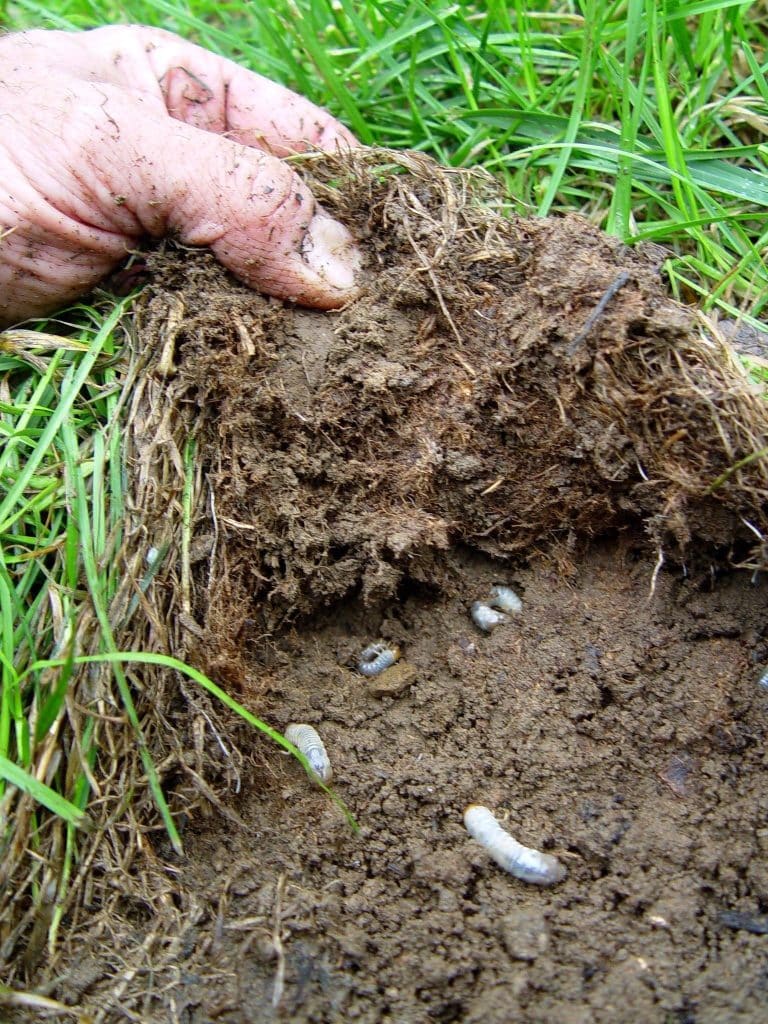
Those eggs hatch in late July and August. The tiny, newly hatched grubs immediately begin feeding on grass roots. They are C-shaped, creamy white, and nearly invisible at first. But they grow fast. By September and October, they have reached their third larval stage — fat, thumb-sized grubs that can chew through root systems at a serious pace.
This is the stage shown in the photo above. When you peel back a section of damaged turf and find those curled-up white grubs in the soil, you are looking at what hatched from the eggs those shiny beetles laid in your lawn weeks earlier.
Purdue Extension (E-271-W) states that healthy turf can tolerate around 8 to 10 grubs per square foot before visible damage appears. Thin or stressed lawns show damage sooner. The damage shows up as irregular brown patches that do not respond to watering — because the roots are gone, not the moisture.
The Timeline That Connects It All
Here is the Japanese beetle calendar for northeast Indiana, based on Purdue and Michigan State Extension research:
Late June through July: Adults emerge and begin feeding on landscape plants. Females lay eggs in turf.
Late July through August: Eggs hatch. Tiny grubs start feeding on grass roots near the soil surface.
September through October: Grubs are at their largest and hungriest. This is when lawn damage shows up — brown patches, spongy turf, and animals digging for grubs.
Late October through March: As soil temperatures drop, grubs burrow 8 to 12 inches deep to overwinter.
April through May: Grubs move back up to the root zone for a brief spring feeding before pupating.
June: New adults emerge, and the cycle starts again.
The whole thing takes exactly one year. And the connection between the two halves matters. The beetles you see skeletonizing your linden tree in July are the parents of the grubs that will be tearing up your lawn in September. Those two problems are not a coincidence — they are cause and effect.
Why Treating One Half Is Not Enough
This is where the Japanese beetle problem gets tricky. Treating only the adults does not solve the grub problem, and treating only the grubs does not stop the adults.
Michigan State Extension makes this point directly: controlling Japanese beetle grubs in your lawn is unlikely to reduce the number of adult beetles feeding on your landscape plants. Adult beetles can fly long distances. Even if you eliminate every grub in your yard, adults from neighboring properties, parks, and fields will still find your roses and lindens.
The reverse is also true. Knocking down the adult beetles on your shrubs does not prevent grubs. Eggs may have already been laid, and beetles from surrounding areas will continue laying more.
That is why we approach Japanese beetles as a whole-property issue. Our arborists treat susceptible trees and shrubs through our tree and shrub care program, protecting the canopy and foliage during peak adult feeding season. And our lawn insect control program targets grubs during the narrow window when they are small and most vulnerable — before the damage shows up in your turf.
Neither treatment alone solves the full problem. Together, they address both halves of the lifecycle.
What September Damage Tells You
If you are reading this in early fall and noticing brown patches in your lawn, grubs may already be at work. Here is how to tell:
The tug test. Grab a handful of brown grass and pull. If it peels back like loose carpet with little resistance, the roots have been chewed away. That is grub damage.
The dig test. Cut a one-foot-square section of turf about three inches deep and flip it over. Count the grubs you see. More than 8 to 10 in that square foot suggests a population high enough to cause damage.
Animal activity. Skunks, raccoons, and crows will tear apart a lawn to get at grubs. If something is digging up your turf at night, it is probably following the food source.
If you are not sure what you are looking at, give us a call at either our Fort Wayne or Marion office. Our team can assess the damage and tell you whether grubs are the cause. By September, the prevention window for this year has passed, but knowing what happened helps us build the right plan for next year — prevention timed to early summer, before the next generation of eggs hatches.
An Ounce of Prevention
The best time to address Japanese beetle grubs is before they become a problem. Preventive grub control, applied in June or early July, targets newly hatched grubs when they are tiny and vulnerable. Purdue Extension recommends this approach for any lawn with a history of grub damage.
Curative treatments can help once grubs are present, but they work best while the larvae are still actively feeding near the surface. Once grubs burrow deep for winter, treatment becomes unreliable.
For the adult beetles on your trees and shrubs, timing also matters. Treatment during the active flight period protects foliage when feeding pressure is highest. Most healthy trees can recover from moderate skeletonizing, but repeated years of heavy defoliation weaken a tree over time — making it more susceptible to other stresses and diseases.
This is exactly the kind of problem where having a professional team that treats both your lawn and your trees makes a real difference. We see the full picture on your property, track beetle activity across our service areas in Fort Wayne and Marion, and time treatments to the biology of the pest — not just the calendar.
Sources
- Purdue Extension E-75-W, “Japanese Beetles in the Urban Landscape” — Link
- Purdue Extension E-271-W, “Managing White Grubs in Turfgrass” — Link
- Michigan State Extension, “How to Choose and When to Apply Grub Control Products for Your Lawn” — Link
- Michigan State Extension, “Japanese Beetle — Integrated Pest Management” — Link
- University of Minnesota Extension, “Japanese Beetles in Yards and Gardens” — Link
- Ohio State Extension BYGL, “White Grub Management” — Link